Astronomy / Astrophysics

A most anticipated analysis in the mission of the space probe Rosetta concerned the water present on the comet 67P/Churyumov-Gerasimenko. The reason is that scientists are looking for a definitive answer to the problem of the origin of water on Earth. Comets are among the main candidates but the analyzes revealed by ESA and published in the journal “Science” show that the water analyzed by Rosetta is different from that on Earth.

An evenly layered rock photographed by the Mast Camera (Mastcam) on the Mars Rover Curiosity shows a pattern typical of a lake-floor sedimentary deposit (Image NASA/JPL-Caltech/MSSS)

Yesterday NASA presented the analyzes of the data collected by the Mars Rover Curiosity in Gale Crater. They indicate that in ancient times it was a lake and that Mount Sharp is the result of progressive sediment deposits in the lake bed in the course of tens of millions of years. This could have happened only if Mars maintained a thick atmosphere with certain levels of temperature and humidity for longer than scientists thought.

A few hours ago the NASA’s space probe New Horizons has sent the first radio signals after being awakened from a hibernation phase. Receiving the diagnostic procedure transmission that followed allowed to confirm that the systems are now fully active and New Horizons is ready to fulfill its primary mission to study Pluto and its moons. The probe will pass within 10,000 kilometers from the dwarf planet in July 2015.

The Japanese space probe Hayabusa 2 lifting off on a H-IIA 202 rocket (Photo courtesy JAXA. All rights reserved)

A few hours ago the Hayabusa 2 space probe was launched on a H-IIA 202 rocket from the Yoshinobu Launch Complex at the Tanegashima center run by JAXA, the Japanese space agency. After almost two hours Hayabusa 2 successfully separated from the rocket’s last stage starting its long voyage towards the asteroid (162173) 1999 JU3.

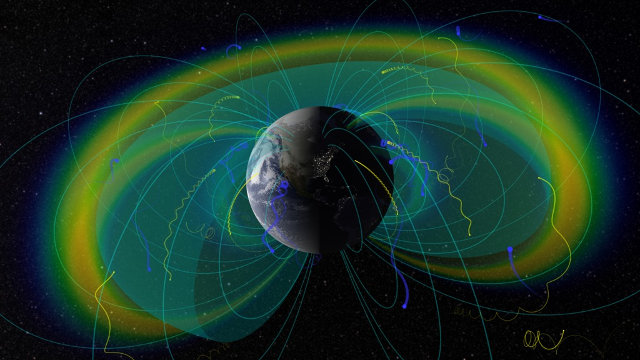
Section of the van Allen Belts (Image NASA/Goddard/Scientific Visualization Studio)

An article just published in the journal “Nature” describes the discovery of a kind of barrier placed in the Van Allen belts, about 11,600 km (aboyt 7,200 miles) above the surface, which prevents very high speed and energy electrons from reaching the Earth. This discovery was made using the Van Allen space probes, launched in August 2012 precisely to study those belts.