Astronomy / Astrophysics

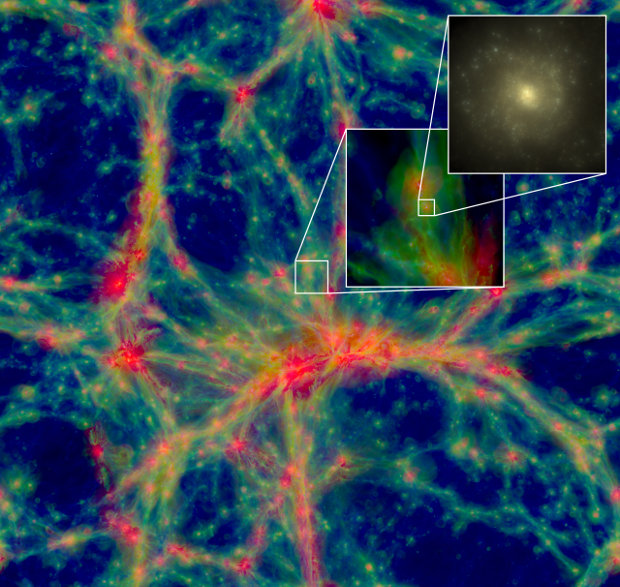
EAGLE image of the simulation of the history of a galaxy with some zooming (Image courtesy EAGLE project. All rights reserved)

A team of astronomers from the Dutch University of Leiden and the British one of Durham created a simulation of the universe called EAGLE (Evolution and Assembly of Galaxies and their Environments). This project is run by the Virgo Consortium which has exactly the aim to produce cosmological simulations using supercomputers. The result, published in the January 2015 edition of the journal “Monthly Notices from the Royal Astronomical Society”, reproduces faithfully the evolution of the galaxies from a very uniform starting point.

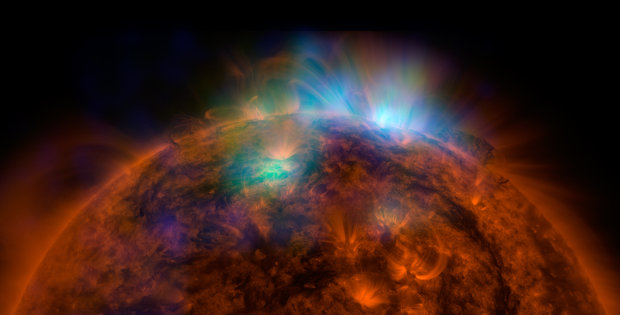
Combined image of Sun observations by NASA's NuSTAR and Solar Dynamics Observatory (SDO) satellites (Image NASA/JPL-Caltech/GSFC)

NASA’s space telescope NuSTAR (Nuclear Spectroscopic Telescope Array), launched in June 2012, was built to study objects such as black holes and for this reason its sensitivity focuses on high-energy X-rays. For once, however, it was used in a way totally different from what was intended to observe the Sun in a new way.

The idea of using NuSTAR to study the Sun came to David Smith, a solar physicist and a member of the NuSTAR team, already seven years ago, during the construction of this space telescope. Fiona Harrison, the project’s principal investigator, initially thought it was a crazy idea but Smith convinced her that it made sense. The purpose of the proposal was to try to observe the faint flashes of X-rays that the Sun emits according to the theoretical predictions.

ESA has declared the end of the Venus Express space probe’s mission. As of November 28, 2014, communications have become unstable and the mission control center lost control of the spacecraft. It was known that it was almost out of fuel but ESA hoped that there was still some increase the altitude of Venus Express to allow it to extend its mission for some more days. Now it’s expected to fall in the atmosphere of the planet Venus, where it will be destroyed by its enormous pressure and its high temperatures corrosive compounds.

The Milky Way's magnetic field along the Galactic plane (ESA/Planck Collaboration. Acknowledgment: M.-A. Miville-Deschênes, CNRS – Institut d’Astrophysique Spatiale, Université Paris-XI, Orsay, France)

At first glance it might seem like a Vincent Van Gogh painting, actually, it’s the visualization of data collected by the Planck Surveyor satellite during its mission, which ended just over a year ago. In the course of about four and a half years, Planck observed the oldest light in the history of the universe but also a nearer light emitted by dust and gas in the Milky Way. The interaction between the interstellar dust in our galaxy and the structure of the galactic magnetic field is portrayed in this amazing image.