Biology

The structure of the various groups of archaea resulting from this study with eukaryotes as part of this taxonomic domain

An article published in the journal “Nature” reports the results of a genetic study on the archaea Asgard that expands the genetic diversity of this group of microorganisms and concludes that the taxonomic order Hodarchaeales is the one most closely related to eukaryotes, the organisms that make up all forms of multicellular life on Earth. A team of researchers conducted a genetic analysis of Asgard archaea from samples collected at 11 locations around the world in a genomic research using state-of-the-art analysis techniques. The conclusion is that eukaryotes constitute a group within the Asgard archaea, from which they may have directly evolved.

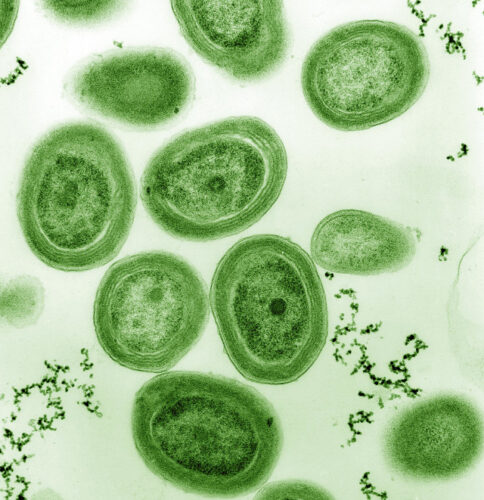
An Asgard archaeon of the proposed species Lokiarchaeum ossiferum

An article published in the journal “Nature” reports a study on archaea that belong to the proposed superphylum called Asgard and in particular on their characteristics that make them a possible evolutionary missing link with eukaryotes. A team of researchers formed by the collaboration of the working groups of Christa Schleper of the Austrian University of Vienna and Martin Pilhofer of ETH Zurich was successful in cultivating a species belonging to this group of microorganisms to study them in the laboratory. This allowed conducting thorough examinations of their cellular structures such as the extensive cytoskeleton.

Thiomargarita magnifica (Photo courtesy Jean-Marie Volland)

An article published in the journal “Science” reports the identification of a bacterium that can reach two centimeters in length, a size that is several thousand times larger than those of most bacteria. A team of researchers named it Thiomargarita magnifica after discovering it in the Guadeloupe archipelago in the Lesser Antilles. It took years to understand its nature because the size, gigantic for a bacterium, and some unusual characteristics for this type of organism initially suggested that it was a multicellular organism, perhaps a fungus.

An illustration of SeqScreen's workflow (A) and the machine learning training framework (B)

An article published in the journal “Genome Biology” reports the results of tests conducted with SeqScreen, a free / open source software developed to recognize genetic sequences existing in pathogenic microorganisms. A team of researchers led by computer scientist Todd Treangen of Rice University and genomics specialist Krista Ternus of the scientific consultancy firm Signature Science, LLC developed SeqScreen to analyze the characteristics of short DNA sequences often called oligonucleotides and improve the recognition techniques of sequences present in a sample that are at least potentially dangerous.

Superworm (Zophobas morio) larva

An article published in the journal “Microbial Genomics” reports the results of a study of the ability to digest polystyrene by the larvae of beetles belonging to the species Zophobas morio, commonly known as superworms, kingworms, or morio worms. A team of researchers from the Australian University of Queensland led by Chris Rinke used a metagenomic technique to analyze these larvae’s gut microbiome to find which microorganisms and in particular which genes are responsible for the digestion of polystyrene. The idea is to produce the enzymes needed to destroy the polystyrene waste in an ecological way.