Biology

Aeta actors on stage

An article published in the journal “Current Biology” reports the results of a genetic research on 118 ethnic groups living in the Philippines which indicated that in the Aeta, or Ayta, people and in particular in the Aeta Magbukon ethnic group there is the greatest concentration found so far of genes inherited from the Denisovans, the human species whose remains identified with certainty have been discovered mainly in Siberia. A team of researchers conducted this genetic research within a collaboration between the Swedish University of Uppsala, the National Commission for Culture and the Arts of the Philippines (NCCA), and various indigenous communities. The results show an ancient interbreeding between the Aeta and the Denisovans.

Two adult males of the Loango Chimpanzee Project (Photo courtesy LCP, Lara M. Southern. All rights reserved)

An article published in the journal “Scientific Reports” reports the observation of two clashes that took place in the Loango National Park, Gabon, between groups of chimpanzees and gorillas that led to the death of two gorilla infants and the injury of three chimpanzees. Lara M. Southern, Tobias Deschner, and Simone Pika reported the chronicle of these two unprecedented clashes since until the first clash the relationships between the two species seemed even friendly. Among the possible explanations is a decline in the availability of fruit that affected various parts of Gabon due to climate change and may have triggered the competition for food up to these outbreaks of violence.

A schematic of how the system called genomatnn recognizes adaptive introgression

An article published in the journal “eLife” reports the development of an approach based on convolutional neural networks (CNNs) to identify genes inherited from other species such as Neanderthals that brought positive effects. A team of researchers led by Graham Gower of the Danish University of Copenhagen developed this deep learning technique to examine genomes of modern humans for examples of what is technically called introgression, which means genes that a hybrid between two species brought into one of his parents’ species. Various possible examples have been found, for example, genes inherited from Denisovans have been found in Melanesians that affect various metabolic and disease-related traits.

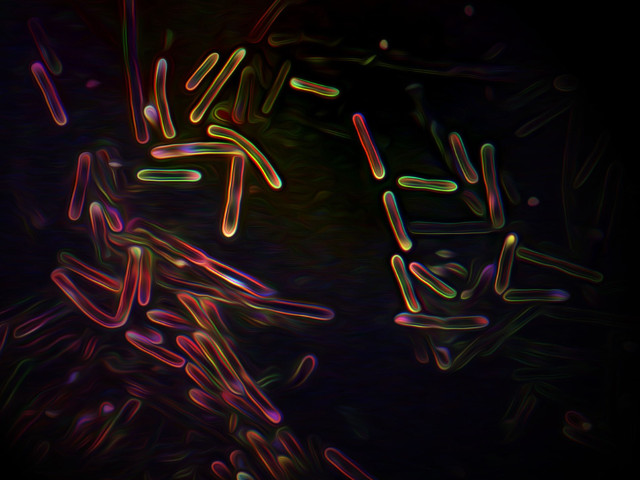
Anthocerotibacter panamensis (Photo courtesy Fay-Wei Li. All rights reserved)

An article published in the journal “Current Biology” reports the discovery of a cyanobacterium that was named Anthocerotibacter panamensis. A team of researchers led by Fay-Wei Li of the Boyce Thompson Institute examined this bacterium discovered on a tropical plant in Panama and found that it has very rare characteristics that make it related to the rarest group of cyanobacteria, Gloeobacteria, which diverged from the most common group, Phycobacteria, about 2 billion years ago. The new species has some characteristics in common with both groups, which offers new insights into these oxygen-producing photosynthetic bacteria.

A moment of the lab work on Escherichia coli (Photo courtesy Rensselaer Polytechnic Institute. All rights reserved)

An article published in the journal “Nature Communications” reports the production of sulfated chondroitin by biosynthesis thanks to genetically modified bacteria of the type Escherichia coli. A team of researchers used a variant of the various CRISPR gene editing techniques called CRISPRi (CRISPR interference) to obtain what, combined with glucosamine, is considered a valid supplement in the treatment of some forms of osteoarthritis. Chondroitin sulfate is normally obtained from the cartilages of animals such as cows, so the ability to generate it using bacteria would offer an ethical and sustainable alternative.