Paleontology

The Shri rapax fossil

An article published in the journal “Historical Biology” reports the identification of a feathered dinosaur species with bird-like features and particularly strong hands. A team of researchers named it Shri rapax after examining a very well-preserved fossil, albeit missing its head. This fossil has a peculiar history, as it was found in the Gobi Desert in Mongolia during an illegal excavation and later smuggled abroad. This makes it more difficult to study a carnivorous species that lived approximately 71 million years ago and is related to the famous Velociraptor, as both are members of the Dromaeosauridae family

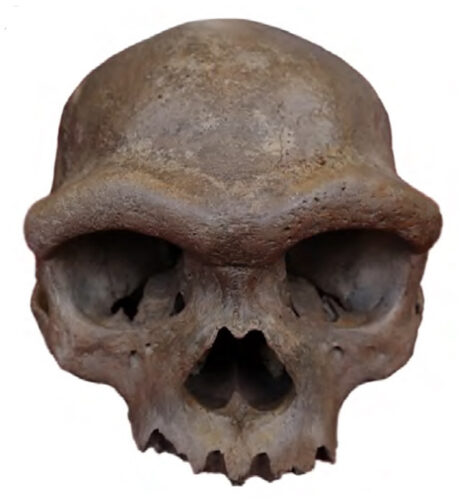
The Harbin Cranium (Image courtesy Fu et al. (2025))

Two articles, one published in the journal “Cell” and one in the journal “Science”, describe two exams conducted on the so-called Harbin Cranium, a fossil discovered in Manchuria, northeastern China, dated at least 146,000 years old. A team of researchers led by paleogeneticist Qiaomei Fu of the Institute of Vertebrate Paleontology and Paleoanthropology in Beijing and Qiang Ji of Hebei University recovered fragments of mitochondrial DNA from the dental calculus still present on the skull and proteins.

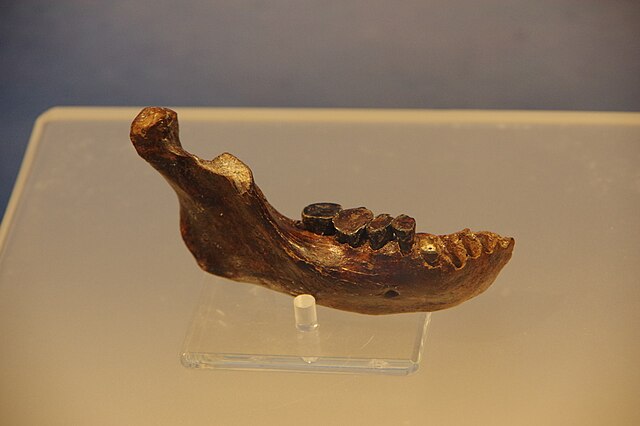
Penghu 1 fossil mandible

An article published in the journal “Science” reports the attribution of a fossil mandible discovered in Taiwan to a Denisovan. A team of researchers conducted an analysis of amino acids still present in the mandible and in the enamel of the teeth still present, detecting two variants that were part of proteins specific to the Denisovan species. These are variants still present in some Asian populations that inherited genes from Denisovans. This discovery expands the area in which traces of this ancient human species have been found, a species that in some ways is still mysterious.

Various views of the holotype of Helmetia expansa (Image courtesy Jean-Bernard Caron and Sarah Losso)

An article published in the “Journal of Systematic PalaeontologyJournal of Systematic Palaeontology” reports a study of Helmetia expansa, a species of arthropod that lived about 505 million years ago, in the Middle Cambrian period. Sarah Losso, Jean-Bernard Caron, and Javier Ortega-Hernández examined the fossils discovered over the years in the famous Burgess Shale site for a total of 36 specimens comparing them with species considered close relatives of Helmetia expansa, as they’re included in the Conciliterga group. Over a century after the discovery of the first fossils, this is the first real description of these arthropods that were probably quite close relatives of trilobites.

The skull cataloged as Kabwe 1 attributed to a Homo heidelbergensis

An article published in the journal “Nature Genetics” reports the results of a sophisticated genetic research that concludes that the species Homo sapiens is the result of the crossbreeding between two populations belonging to different species of hominins. Trevor Cousins, Aylwyn Scally, and Richard Durbin of the British University of Cambridge developed a genetic analysis software called cobraa to create models of ancient human populations splitting apart and merging back. The application of cobraa to the genetic data obtained from modern humans from all over the world indicates a split between two populations dating back to about 1.5 million years ago to a crossbreeding between their descendants about 300,000 years ago. The two species could be Homo erectus and Homo heidelbergensis but for now, these are hypotheses.