Paleontology

Fossil of Chengjiangocaris kunmingensis and the magnification of part of its nervous cord (Image courtesy Jie Yang (top), Yu Liu (bottom))

An article published in the journal “Proceedings of the National Academy of Sciences” describes a research conducted on five fossils of Chengjiangocaris kunmingensis, a crustacean-like arthropod that lived about 520 million years ago in today’s China. They preserved beautifully, so much that their individual nerves are visible making them the oldest fossils to show such details.

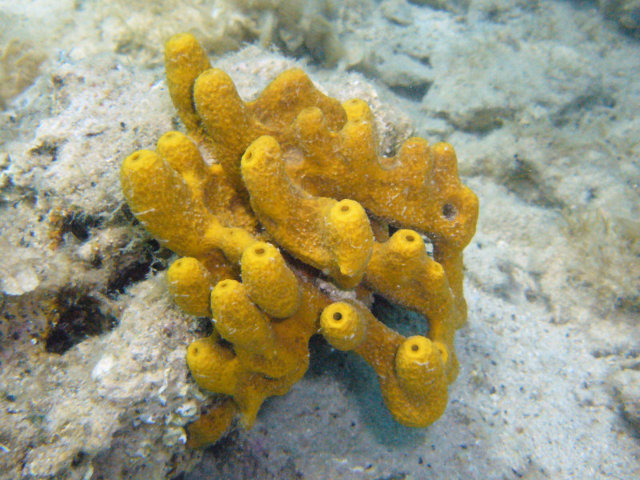
A sea sponge of the species Aplysina aerophoba

An article published in the journal “Proceedings of the National Academy of Sciences” describes a research that provides evidence that ancient sea sponges were the first animals existed on Earth. A study led by Dr. David Gold of MIT (Massachusetts Institute of Technology) reached this conclusion by analyzing an unusual molecule found in 640 million years old rocks.

Reconstruction of a trilobite attacking a worm-like prey (Image courtesy Stacy Turpin Cheavens of the Department of Orthopaedic Surgery, University of Missouri)

An article published in the journal “Palaeogeography, Palaeoclimatology, Palaeoecology” describes a research of truly exceptional fossils because they kept in ancient ocean sediments the traces left in the Cambrian by trilobites and their prey, worm-like creatures. Their analysis reveals the trilobites’ predatory behavior, which was already sophisticated more than half a billion years ago.

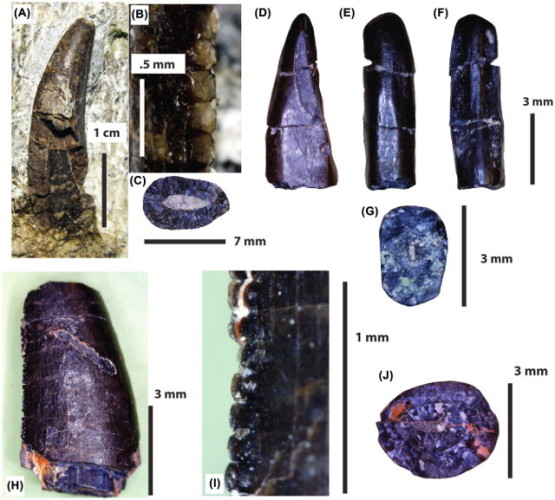
Tyrannosauroid teeth (Image courtesy L.J. Krumenacker, D. Jade Simon, Garrett Scofield & David J. Varricchio. All rights reserved)

An article published in the journal “Historical Biology: An International Journal of Paleobiology” describes various dinosaur fossils discovered in Idaho, USA. Those are several species belonging to the theropod (Theropoda) suborder showing a much greater diversity than was known. The fossils date back about 95 million years ago and according to the team of paleontologists who examined them also include tyrannosaur ancestors.

New hominin molar found at the Sterkfontein Caves (Photo courtesy Jason Heaton. All rights reserved)

An article published in “Journal of Human Evolution” describes the exam of some fossils belonging to the genus Homo which may be associated with early stone tools dated at around 2.18 million years ago. Those are a finger bone and of a molar found in the Sterkfontein Caves, in South Africa. Their features make their precise attribution difficult but intriguing.