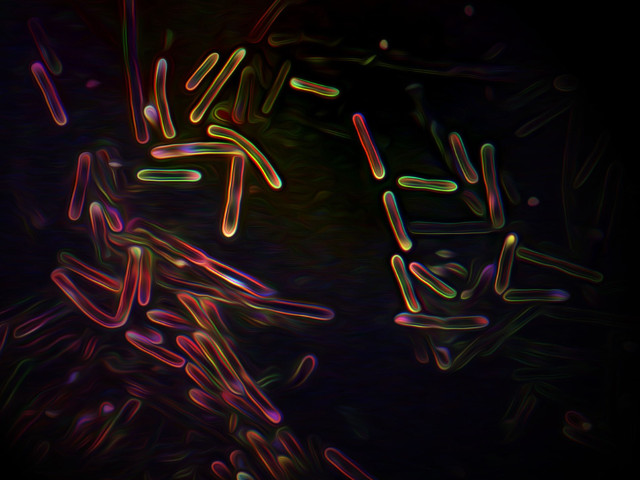
Bacteria

Some microfossils object of this study (Image courtesy D. Papineau)

An article published in the journal “Science Advances” reports the results of a thorough examination of a rock dated between 3.75 and 4.25 billion years offering evidence of the presence of microfossils. A team of researchers discovered in a rock found in the Nuvvuagittuq Greenstone Belt, Quebec, fossilized structures that bear similarities to microfossils from a later era and to today’s bacteria living in hydrothermal vents. This discovery offers new evidence that at the time, there were already diversified life forms after the evidence published in an article in the journal “Nature” in March 2017. In that case, the nature of the structures sparked controversy but the ones presented in the new study have greater complexity.

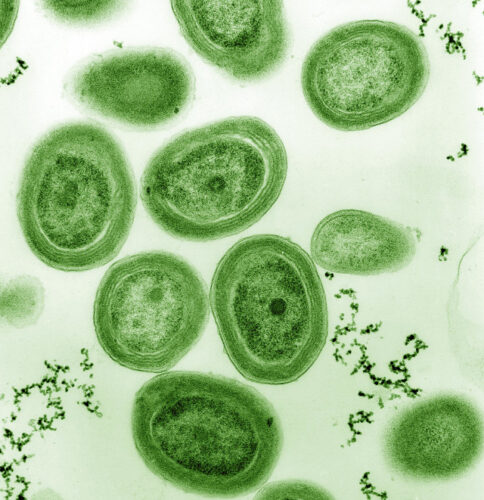
Cyanobacteria of the species Prochlorococcus marinus

An article published in the journal “Proceedings of the Royal Society B: Biological Sciences” reports the results of a study on the origin of oxygenic photosynthesis. A team of researchers developed a new gene analysis technique to estimate the origin of cyanobacteria capable of oxygenic photosynthesis. The conclusion is that all the species of these cyanobacteria existing today have a common ancestor that dates back to about 2.9 billion years ago and that the ancestors of cyanobacteria branched off from other bacteria about 3.4 billion years ago. Oxygenic photosynthesis probably evolved during that time interval.

Anthocerotibacter panamensis (Photo courtesy Fay-Wei Li. All rights reserved)

An article published in the journal “Current Biology” reports the discovery of a cyanobacterium that was named Anthocerotibacter panamensis. A team of researchers led by Fay-Wei Li of the Boyce Thompson Institute examined this bacterium discovered on a tropical plant in Panama and found that it has very rare characteristics that make it related to the rarest group of cyanobacteria, Gloeobacteria, which diverged from the most common group, Phycobacteria, about 2 billion years ago. The new species has some characteristics in common with both groups, which offers new insights into these oxygen-producing photosynthetic bacteria.

A moment of the lab work on Escherichia coli (Photo courtesy Rensselaer Polytechnic Institute. All rights reserved)

An article published in the journal “Nature Communications” reports the production of sulfated chondroitin by biosynthesis thanks to genetically modified bacteria of the type Escherichia coli. A team of researchers used a variant of the various CRISPR gene editing techniques called CRISPRi (CRISPR interference) to obtain what, combined with glucosamine, is considered a valid supplement in the treatment of some forms of osteoarthritis. Chondroitin sulfate is normally obtained from the cartilages of animals such as cows, so the ability to generate it using bacteria would offer an ethical and sustainable alternative.

Bacteria sample (Image courtesy JAMSTEC. All rights reserved)

An article published in the journal “Nature Communications” reports the discovery of living colonies of bacteria in sediment layers up to 101.5 million years old in the depths of the Pacific Ocean area called the South Pacific Gyre. A team of researchers led by JAMSTEC’s Dr. Yuki Morono drilled the ocean floor in an area where it’s nearly 6 kilometers deep to collect many sediment samples up to 100 meters below the ocean floor. This is the Pacific area with the lowest productivity and the least amount of nutrients available, yet the researchers found bacteria in the sediments that are millions of years old and managed to bring them back to full metabolic activity.