Dinosaurs

Oculudentavis khaungraae fossil

An article published in the journal “Nature” reports the identification of a small bird-like dinosaur from the examination of a skull preserved in a piece of amber dating back to about 99 million years ago, in the Cretaceous period, found in Myanmar. A team of researchers named it Oculudentavis khaungraae and it could be the smallest dinosaur ever, with a size comparable to a hummingbird’s. However, the identification is disputed even if, at least for now, counterarguments have only been published in an article of the Chinese Institute of Vertebrate Paleontology and Paleoanthropology (IVPP).

Isolated chondrocytes of Hypacrosaurus stebingeri and emu

An article published in the journal “National Science Review” reports evidence of the identification of proteins, chromosomes and DNA markers in the fossil cartilage of a Hypacrosaurus stebingeri nestling, a dinosaur belonging to the hadrosaur family dating back to around 75 million years ago, in the Cretaceous period. A team of researchers led by Alida Bailleul of the Institute of Vertebrate Paleontology and Paleoanthropology, China, used chemicals that bind to DNA in living cells on fossil bone fragments resulting in a fluorescence indicating that they bonded to the original molecules and not to external contaminants. Jurassic Park remains science fiction because the fragments found may have undergone various alterations but any trace of cell structures, proteins and chromosomes could offer new information on these dinosaurs.

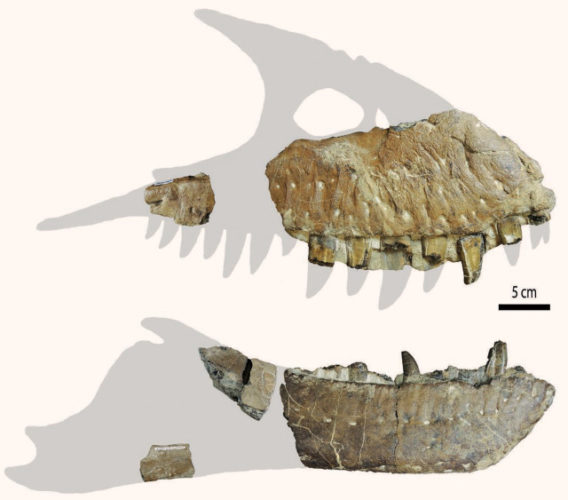
Thanatotheristes degrootorum fossil bones

An article published in the journal “Cretaceous Research” reports the identification of a new species of tyrannosaurid that lived in today’s Canada about 80 million years ago, in the Cretaceous period. A team of researchers named it Thanatotheristes degrootorum after examining a partial skull with the bones of the upper and lower jaws, discovered in 2010 near the city of Hays. The characteristics of the available fossils convinced the researchers that it was a tyrannosaurid of a different species from the ones already known, the oldest discovered in Canada, useful to understand the evolution of the family to which the iconic T. rex belongs.

Cast of Allosaurus jimmadseni (Image courtesy Dan Chure)

An article published in the journal “PeerJ” reports the identification of a new species of carnivorous dinosaur that lived between 152 and 157 million years ago, in the Jurassic period. Daniel Chure and Mark Loewen named it Allosaurus jimmadseni after examining various fossils discovered in the 1990s in Utah and Wyoming to determine that it’s a new species of allosaurus, a few million years older than the first one discovered, Allosaurus fragilis. The differences between the two species suggest different eating habits.

Skeleton of the probable T. rex nicknamed Jane (Photo courtesy Zissoudisctrucker)

An article published in the journal “Science Advances” reports a study that offers an analysis of the fossils of what was classified as Nanotyrannus offering evidence that actually they’re young specimens of Tyrannosaurus rex. A team of researchers led by Dr. Holly Woodward of the Oklahoma State University Center for Health Science conducted a paleohistological examination on bone fragments of the specimens nicknamed Jane and Petey concluding that fibers and other microstructures were growing. According to their estimates, Jane was around 13 years old at the time of death while Petey was around 15 years old.