Dinosaurs

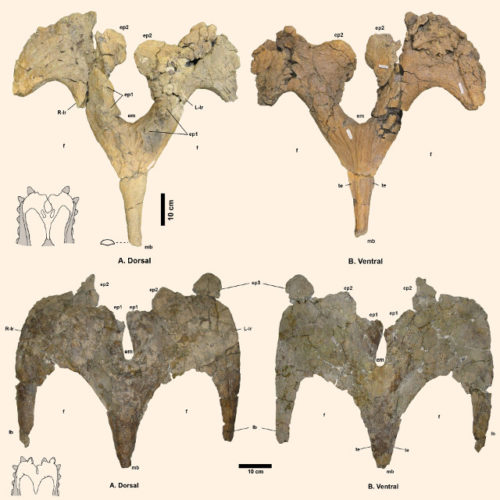
Bones of Navajoceratops sullivani and Terminocavus sealeyi

An article published in the journal “PeerJ” reports the discovery of two species of horned dinosaurs that lived about 75 million years ago, in the Cretaceous period, in today’s New Mexico, USA. Dr. Denver W. Fowler and Dr. Elizabeth A. Freedman Fowler examined fragments of skulls discovered in the Kirtland Formation, New Mexico, and attributed them to two hitherto unknown species of herbivorous dinosaurs from the ceratopsid family naming them Navajoceratops sullivani and Terminocavus sealeyi. According to the two researchers, these are transitional species between two previously known species: Pentaceratops sternbergii and Anchiceratops ornatus. This could also be true for a third possible species that appears to belong to the same group even if researchers haven’t identified it with certainty due to the fragmentary nature of the fossils discovered.

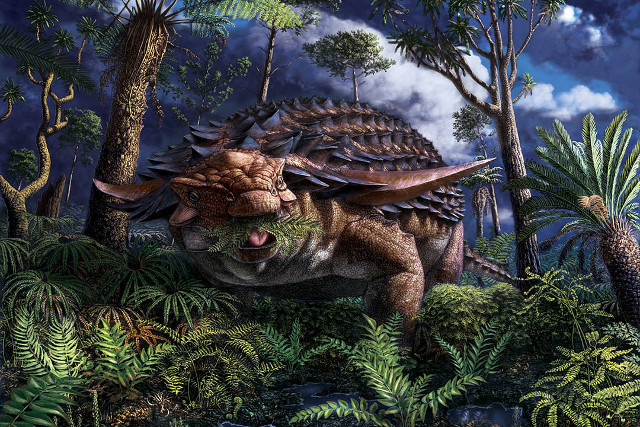
Artist's concept of Borealopelta markmitchelli (Image courtesy Julius Csotonyi © Royal Tyrrell Museum of Palaeontology)

An article published in the journal “Royal Society Open Science” reports a study on the last meal of the only known specimen of Borealopelta markmitchelli. The exceptional conservation of this armored dinosaur fossil, a nodosaurid ankylosaur, has also made it possible to find what is by far the best-preserved dinosaur stomach discovered so far. This allowed a team of researchers to examine this stomach and its contents, a mass the size of a soccer ball. The result is definitive evidence of the diet of these herbivorous animals and offers much more information on the interaction with their environment than just the skeleton.

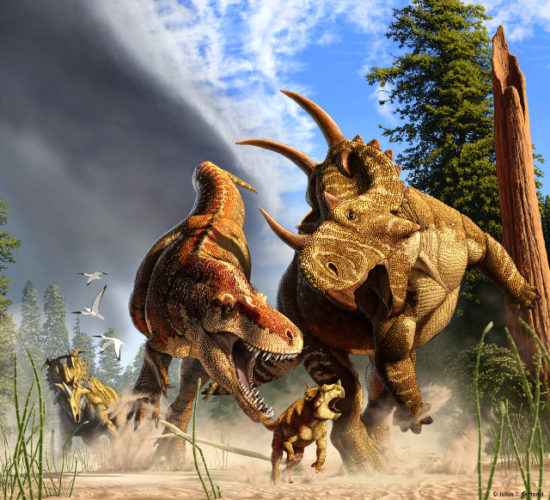
A Daspletosaurus chasing Spinops (Image courtesy Julius Csotonyi)

An article published in the journal “PLOS ONE” reports a study on the locomotion capabilities of the dinosaurs of the theropod group, and in particular of more than 70 species belonging to the carnivorous groups Tyrannosauridae, which includes T. rex, Allosauroidea and Ceratosauridae. A team of researchers considered various physical characteristics to evaluate the allometry impact on those dinosaurs’ ability to run and the limiting effect of their size, aspects that are generally overlooked. One conclusion is that large predators such as T. rex had the advantage of efficiency thanks to their long legs, not of speed as previously thought.

Massospondylus carinatus skeleton reconstruction

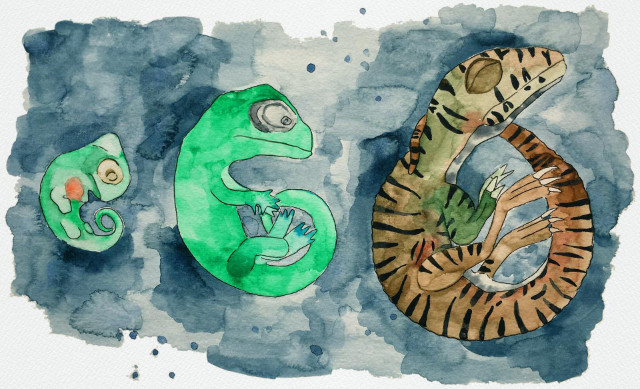
An article published in the “Scientific Reports” journal reports a 3D reconstruction of some of the oldest known dinosaur embryos, which belong to the species Massospondylus carinatus. Kimberley “Kimi” Chapelle, Vincent Fernandez, and Jonah Choiniere subjected the fossils to a very special CT-scan, an exam that was conducted at the European Synchrotron Radiation Facility (ESRF) in Grenoble, France, using an 844-meter-long particle accelerator. The result is that the eggs containing those embryos fossilized when they were at about 60% of their development, which is similar to that of some of the closest relatives of the dinosaurs existing today: crocodiles, chickens, turtles and lizards.

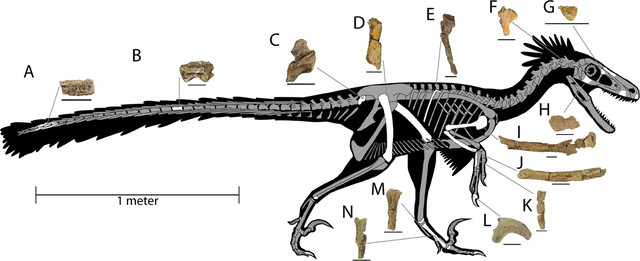
Dineobellator notohesperus skeleton

An article published in the journal “Scientific Reports” describes the identification of a feathered dinosaur that lived about 67 million years ago, in the Cretaceous period, in today’s New Mexico, USA. Steven E. Jasinski, Robert M. Sullivan, and Peter Dodson named it Dineobellator notohesperus after studying the available bones, only a few of them but enough to establish that it was a new genus, albeit closely related to the Velociraptor. These species are cataloged in the Velociraptorinae subfamily and in the Dromeosauridae family, a group of generally small and lightly built dinosaurs, so their remains are rare and any new discoveries help to reconstruct the history of the non-avian dinosaurs that could be the closest relatives of modern birds.