Hardware

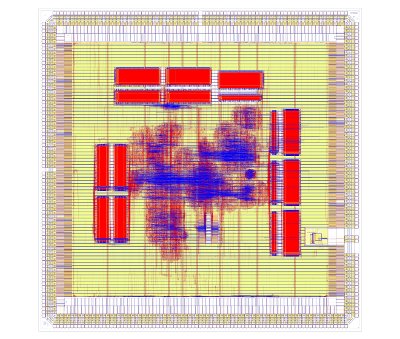
Layout of the LEON2-FT microprocessor also known by its commercial name AT697

Not only human beings can have problems during space missions because of the radiations but also electronic equipment may suffer malfunctioning. For this reason, there are microprocessors designed specifically to work in those conditions. Since the ’90s, ESA plans microprocessors starting from existing designs and adapting them to be used in space missions. Today ESA uses microprocessors of the LEON series.

Image of Mars received by the Deep Space Antenna 3 station (Photo ESA)

Tuesday, near Malargüe, a city in Argentina about 1,550 meters above sea level, the new ESA’s Deep Space Antenna 3 (DSA 3) station was officially opened, a parabolic antenna of 35 meters in diameter capable to transmit and receive in the X-band and receive in the Ka band. The structure that supports the moving antenna is 40 meters high and weighs 610 tons.

A portion of an IBM nanophotonic chip. In blue the optical waveguides transmitting high-speed optical signals and in yellow the copper wires carrying high-speed electrical signals (Image courtesy International Business Machines Corporation. All rights reserved)

IBM announced that a significant step forward in what is called silicon nanophotonics, which the integration of optical communications with common silicon chips. This technology uses light pulses instead of electrical signals for communications and provides a kind of highway to transport large volumes of data between silicon chips.