Hominins

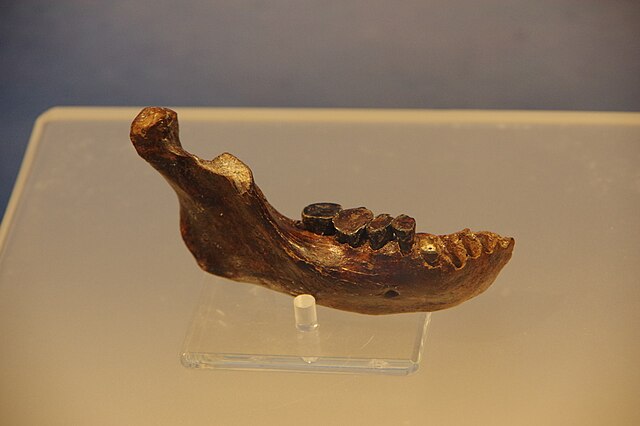
Penghu 1 fossil mandible

An article published in the journal “Science” reports the attribution of a fossil mandible discovered in Taiwan to a Denisovan. A team of researchers conducted an analysis of amino acids still present in the mandible and in the enamel of the teeth still present, detecting two variants that were part of proteins specific to the Denisovan species. These are variants still present in some Asian populations that inherited genes from Denisovans. This discovery expands the area in which traces of this ancient human species have been found, a species that in some ways is still mysterious.

The skull cataloged as Kabwe 1 attributed to a Homo heidelbergensis

An article published in the journal “Nature Genetics” reports the results of a sophisticated genetic research that concludes that the species Homo sapiens is the result of the crossbreeding between two populations belonging to different species of hominins. Trevor Cousins, Aylwyn Scally, and Richard Durbin of the British University of Cambridge developed a genetic analysis software called cobraa to create models of ancient human populations splitting apart and merging back. The application of cobraa to the genetic data obtained from modern humans from all over the world indicates a split between two populations dating back to about 1.5 million years ago to a crossbreeding between their descendants about 300,000 years ago. The two species could be Homo erectus and Homo heidelbergensis but for now, these are hypotheses.

The areas where the fossils object of the study on the inner ear were found with the one called Almud 1 enlarged and a reconstruction of the inner ear's semicircular canals

An article published in the journal “Nature Communications” reports the results of the study of the inner ear of Neanderthals that suggests that at a certain point in their history there was a genetic bottleneck that may have contributed to their extinction. A team of researchers examined the semicircular canals, structures whose development is strongly determined by genes, to assess the history of Neanderthals. According to the conclusions, the morphological diversity of these anatomical structures shows a decline about 110,000 years ago.

This is not the only recent research that suggests a genetic stagnation of Neanderthals because a few weeks ago, an article was published in the journal “Scientific Reports” that focuses on the blood groups of Homo sapiens, Denisovans, and Neanderthals. Genetic analysis shows that Neanderthals had a blood type that’s very rare in Homo sapiens with very limited variability over about 80,000 years. This may have made them vulnerable to various health problems.

A scheme of the organization of the fossils of Asian hominins from the Late Quaternary

An article published in the journal “Nature Communications” reports comments on the variability of hominins that inhabited East Asia between 300,000 and 50,000 years ago and the proposal of a new species named Homo juluensis that includes fossils discovered in various parts of Asia, including those attributed to the Denisovans. Professor Christopher J. Bae of the University of Hawaii at Mānoa and Xiujie Wu of the Chinese Academy of Sciences attempted to bring order to the organization of Asian hominin fossils from the Late Quaternary with the aim of creating a clearer system for understanding the human species that lived in Asia.

Views of a partial humerus (a-f), including one obtained with a micro-CT scan (g), of Homo floresiensis found at the site of Mata Menge compared with some views of a humerus (h-i) found at the site of Liang Bua

An article published in the journal “Nature Communications” reports a study on new fossils belonging to the hominins called Homo floresiensis and nicknamed hobbits found at the site of Mata Menge, on the island of Flores. A team of researchers examined these new fossils dated to about 700,000 years ago and concluded that the species Homo floresiensis could descend from Asian Homo erectus.

The discovery of hominins just over a meter tall in a cave at Liang Bua, on the island of Flores, aroused much curiosity and not only among professionals in the field. Nicknamed hobbits because of their small height, they stimulated discussions since the beginning about their origin and relationships with other hominins, especially with Homo sapiens.