Hominins

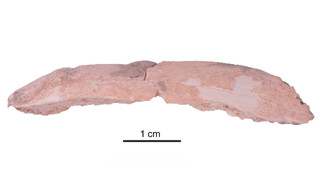
The partial rib attributed to a Denisovan

An article published in the journal “Nature” reports the results of a study of over 2,500 fossils found in the Baishiya Karst Cave, in the Chinese region of Xiahe, on the Tibetan plateau, among which a partial rib attributed to a Denisovan. A team of researchers used an analysis technique called Zooarchaeology by Mass Spectrometry (ZooMS) to attribute isolated and often fragmented bones to the right species through collagen characteristics. According to the researchers, the Denisovans may have lived in that cave between 200,000 and 40,000 years ago.

Homo sapiens and Neanderthal skulls

An article published in the journal “Science Advances” reports the results of a genetic analysis that reconstructs the interbreeding between Homo sapiens and Neanderthals that occurred during the migrations of populations of these two species. A team of researchers from the University of Geneva, Switzerland, analyzed the DNA of over 4,000 Homo sapiens who lived in Eurasia over the last 40,000 years. The results show variations in the presence of genes inherited from Neanderthals following various interbreedings in different populations and at different times.

Various views of the partial skull of Anadoluvius turkae

An article published in the journal “Communications Biology” reports the assignment of fossils discovered in Anatolia in 2015 to a new species and a new genus of primitive hominins which was named Anadoluvius turkae. A team of researchers examined these fossils that form a partial skull discovered at the Çorakyerler site dating back to about 8.7 million years ago, in the Miocene period, concluding that it’s an ancestor of humans and great apes. This indicates that hominins evolved in Europe diversifying across the continent for a few million years before migrating to Africa, where the various hominin species already known evolved.

The KNM-ER 741 tibia with the cuts in the magnified area (Photo courtesy Jennifer Clark)

An article published in the journal “Scientific Reports” offers evidence that hominins who lived at least 1.45 million years ago killed each other and possibly practiced cannibalism. Paleoanthropologist Briana Pobiner of the National Museum of Natural History led the study of the markings found on a fossil tibia discovered in northern Kenya. The examination of 3D models of the surface of this tibia indicates that 11 of those marks were left by stone tools and that their characteristics likely indicate butcher work much like that seen on fossil animal bones slaughtered by hominins for consumption.

A reconstruction of a Homo naledi skeleton in the position in which it was found (Image courtesy Berger et al., 2023)

Three articles under peer review ahead of a publication in the journal “eLife” report different aspects of a study of what were defined as intentional burials of individuals belonging to the species Homo naledi. Various researchers including Dr. Lee Berger, who led the team that discovered these hominins, examined the cave called Rising Star, about 50 km northwest of Johannesburg, South Africa, in which their fossils were discovered and what were interpreted as engravings of symbols accompanying those burials. This would mean that Homo naledi buried their dead between 241,000 and 335,000 years ago, 100,000 years before Homo sapiens.