Planets

An evenly layered rock photographed by the Mast Camera (Mastcam) on the Mars Rover Curiosity shows a pattern typical of a lake-floor sedimentary deposit (Image NASA/JPL-Caltech/MSSS)

Yesterday NASA presented the analyzes of the data collected by the Mars Rover Curiosity in Gale Crater. They indicate that in ancient times it was a lake and that Mount Sharp is the result of progressive sediment deposits in the lake bed in the course of tens of millions of years. This could have happened only if Mars maintained a thick atmosphere with certain levels of temperature and humidity for longer than scientists thought.

A few hours ago the NASA’s space probe New Horizons has sent the first radio signals after being awakened from a hibernation phase. Receiving the diagnostic procedure transmission that followed allowed to confirm that the systems are now fully active and New Horizons is ready to fulfill its primary mission to study Pluto and its moons. The probe will pass within 10,000 kilometers from the dwarf planet in July 2015.

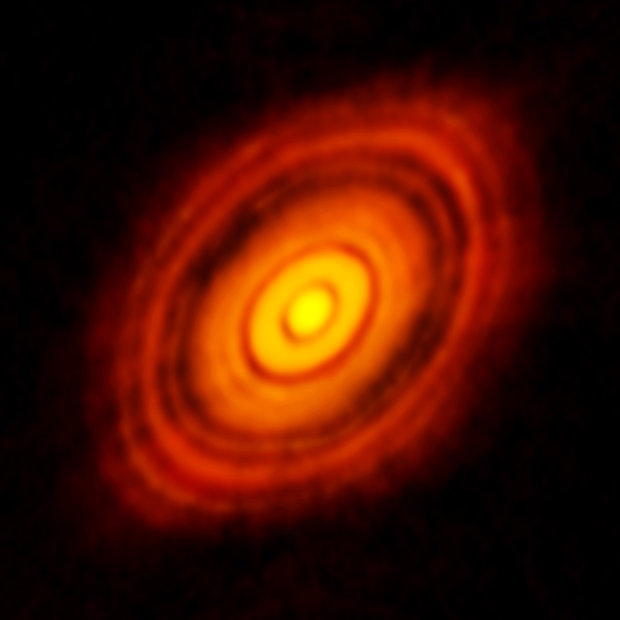
Picture of the HL Tauri system with its forming planets taken by the ALMA telescope (Image ALMA (ESO/NAOJ/NRAO))

In September 2014, ESO’s ALMA (Atacama Large Millimeter/submillimeter Array) telescope began the long baseline campaign, the one with the antennas separated by the maximum length achieved so far, which is 15 km away (a little more than 9 miles). In this mode, more powerful than before, ALMA observed with great results HL Tauri, a young star about 450 light years from Earth. It’s surrounded by a disk of dust that is slowly coalescing in certain areas to form planets.

The Kandinsky crater on Mercury photographed by the Messenger space probe (Image ASA/Johns Hopkins University Applied Physics Laboratory/Carnegie Institution of Washington)

An article published in the journal “Geology” illustrates the discovery of water ice on the planet Mercury made ​​thanks to NASA’s Messenger (Mercury Surface, Space Environment, Geochemistry and Ranging) space probe. Several pictures show frozen water and other materials in permanently shadowed craters near Mercury’s north pole.

Image of the Mars atmosphere taken by MAVEN's IUVS instrument (Image Laboratory for Atmospheric and Space Physics, University of Colorado; NASA)

During the last week, two spacecraft successfully entered the planet Mars orbit, the American MAVEN and the Indian MOM, informally known as Mangalyaan. Both NASA and ISRO, the Indian Space Agency which is now starting being well known in the world, immediately started test operations of their probes, which sent the first images of the red planet.