Planets

The Kepler space telescope opened a new era in the search for exoplanets finding more than 4,000 candidates of which nearly a thousand candidates have been confirmed. The SETI (Search for Extraterrestrial Intelligence) project has recently studied 86 planets found by 2011 to search for radio signals that could indicate the potential presence of an alien civilization.

After nearly a month spent going in and out the upper layer of the atmosphere of Venus, at an altitude between 130 and 135 km (about 81 to 84 miles), in recent days the Venus Express spacecraft has started the series of maneuvers that will bring it up to around 460 km (about 286 miles) of altitude. It wasn’t certain that Venus Express could survive the harsh conditions that are found even at those altitudes but this success will allow the probe to make a few more detections before running out of fuel and finally falling to the planet.

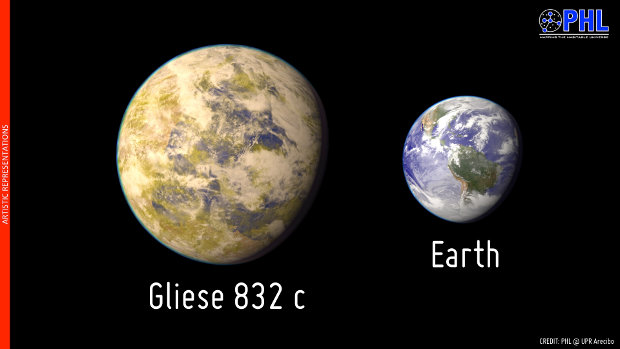
Artistic representation of the planet Gliese 832c neart the Earth (Image courtesy PHL @ UPR Arecibo)

An international team of astronomers led by Robert A. Wittenmyer of UNSW Australia has announced the discovery of the planet Gliese 832c, about sixteen light years from Earth. According to preliminary assessments carried out on the similarity of this planet with the Earth, it’s one of the best candidates for potential habitability found so far.

An image of the star HR 4796A and the dust ring around it taken by SPHERE (Image ESO/J.-L. Beuzit et al./SPHERE Consortium)

SPHERE (Spectro-Polarimetric High-contrast Exoplanet REsearch), a new instruments that combines different advanced techniques to directly photograph planets in other solar systems, has been activated for its test phase. At the end of 2013 scientists verified that it worked in Europe and they shipped it to Chile to be installed on ESO’s Very Large Telescope (VLT) at the Paranal Observatory in Chile.

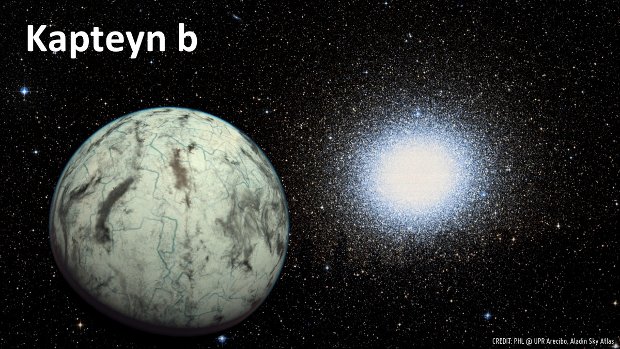
Artistic impression of the planet Kapteyn b with the 0mega Centauri cluster in the background (Image courtesy PHL / UPR Arecibo / Aladin Sky Atlas. All rights reserved)

An international team of astronomers led by Guillem Anglada-Escude of the Queen Mary University, London, announced that they have found two planets that orbit the Kapteyn’s star, only 13 light years from Earth. In particular, the planet Kapteyn b is interesting because it is a super-Earth, meaning a rocky planet with a mass about five times the Earth, where liquid water could exist, one of the essential requirements to host life as we know it.