Space probes

The Kandinsky crater on Mercury photographed by the Messenger space probe (Image ASA/Johns Hopkins University Applied Physics Laboratory/Carnegie Institution of Washington)

An article published in the journal “Geology” illustrates the discovery of water ice on the planet Mercury made ​​thanks to NASA’s Messenger (Mercury Surface, Space Environment, Geochemistry and Ranging) space probe. Several pictures show frozen water and other materials in permanently shadowed craters near Mercury’s north pole.

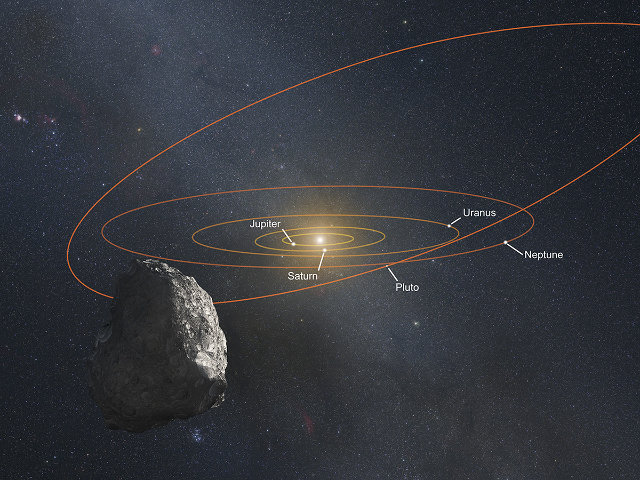
Artistic concept of a Kuiper Belt Object with its orbit compared to the ones of some planets (Image NASA, ESA, and G. Bacon (STScI))

NASA announced that it identified three potential targets for the mission of the New Horizons spacecraft after its Pluto flyby. They are Kuiper Belt Objects (KBOs) found using the Hubble Space Telescope exactly for this purpose.

The research program of KBOs was successful from the start, leading to the discovery of two interesting objects and then three more. In particular, the first object discovered, identified as 1110113Y, was subsequently defined certainty targetable. For this reason, it’s called PT1 by the team of the New Horizons mission.

The independent inquiry board tasked with identifying the cause of the anomaly in the August 22, 2014 launch of the two satellites of the Galileo constellation announced its findings. The unofficial news that came at the end of September, which blamed a malfunction in the rocket’s Fregat upper stage. The freezing of the hydrazine used as a fuel resulted in the inability to insert the satellites in their correct orbit.

The pieces of the Tunable Laser Spectrometer (TLS) (Image NASA/JPL-Caltech)

Pacific Gas and Electric Company (PG&E) is a subsidiary of PG&E Corporation and is a major natural gas utility in the USA. The company is now testing a new device for the detection of methane leaks based on an instrument of the Mars Rover Curiosity. Developed to find out if there is methane on Mars, a possible trace of biochemical reactions, this instrument is a thousand times more sensitive than those used so far by PG&E to detect leaks of methane.