Space probes

The Philae lander seen by the Rosetta space probe during its descent on the comet 67P/Churyumov-Gerasimenko (Image ESA/Rosetta/MPS for OSIRIS Team MPS/UPD/LAM/IAA/SSO/INTA/UPM/DASP/IDA)

ESA has just confirmed that the Philae lander successfully landed on the surface of the comet 67P/Churyumov-Gerasimenko. It’s the first time that a spacecraft arrived from Earth manages to land on the surface of a comet. This success is the culmination of many years of effort but it’s just the beginning of a new phase of the Rosetta mission.

The Chang'e 5 T1 Capsule after its landing (Photo courtesy Xinhua. All rights reserved)

It was morning in China when the Chinese test capsule Chang’e 5 T1 landed successfully in Mongolia. The mission was launched on October 23 and in the following days flew around the Moon before returning to Earth. The spacecraft was composed of a service module and a return vehicle, which is the capsule that has landed.

Image of emissions of water vapor and other compounds from the comet 67P/Churyumov-Gerasimenko taken by one of the cameras of the Rosetta space probe's OSIRIS set (Image ESA/Rosetta/MPS for OSIRIS Team MPS/UPD/LAM/IAA/SSO/ INTA/UPM/DASP/IDA)

While the Rosetta space probe’s Philae lander prepares to land on the comet 67P/Churyumov-Gerasimenko on November 12, the analyzes at a distance go on. The comet is about 450 million kilometers (about 280 million miles) from the Sun and its activity is increasing due to the sublimation of the ice, which becomes steam. The ROSINA (Rosetta Orbiter Spectrometer for Ion and Neutral Analysis) instrument has already analyzed some emissions finding that the comet really stinks.

The Chinese Chang’e 5-T1 mission at its beginning with a Long March 3C/E blasting off (Photo courtesy Xinhua/Jiang Hongjing. All rights reserved)

It was night in China when the Chang’e-5 T1 started successfully. A Long March 3C/E rocket blasted off from the Xichang satellite launch center and successfully sent an experimental spacecraft on a trip around the Moon. The mission is expected to last just over eight days to test some technologies needed in 2017, when China will send a robotic spacecraft to the Moon to collect samples to be returned to Earth.

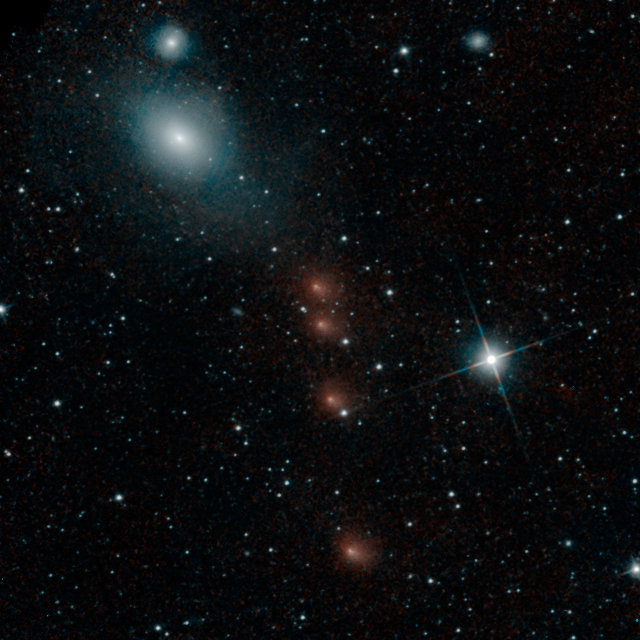
The comet C/2013 A1 Siding Spring observed by the WISE space telescope (Image NASA/JPL-Caltech)

Yesterday the comet C/2013 A1, also known as Siding Spring, passed very close to Mars. The distance from the planet was as low as about 140,000 km (about 87,000 miles), one third of the distance of the Moon from Earth, very close in astronomical terms. The event was followed by several telescopes but nearby ther was was the Earth’s “star fleet” consisting of NASA’s probes and rovers, ESA’s Mars Express probe and the Indian MOM – aka Mangalyaan – probe.