Stars

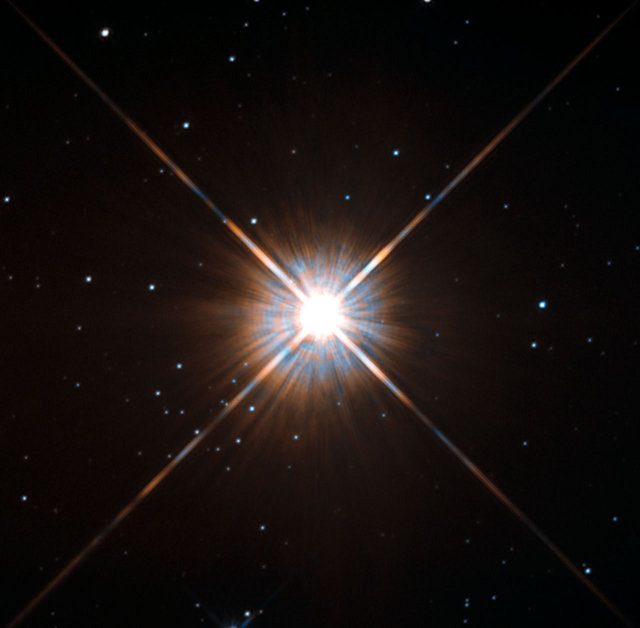
A very bright Proxima Centaury in a picture taken by the Hubble Space Telescope (Photo ESA/Hubble & NASA)

The Hubble Space Telescope has taken a picture of the star Proxima Centauri, the closest to the Sun, using its Wide Field and Planetary Camera 2 (WFPC2) instrument. It’s in the neighborhood in astronomical terms, just over 4 light-years from Earth, but generally its light is very dim. Occasionally, however, Proxima Centauri is particularly brilliant.

Artist impression of a protostar in the Infrared Dark Cloud MM3 (Image Courtesy of the National Astronomical Observatory of Japan. All rights reserved)

An international team led by Takeshi Sakai of the University of Electro-Communication, Japan, used the ALMA (Atacama Large Millimeter/submillimeter Array) radiotelescope to study a newborn star. Known only as G34.43+00.24 MM3 or more simply as MM3, this star is so young that it’s still surrounded by a huge cocoon of gas, a cloud about ten times larger than any other observed around stars of solar mass.

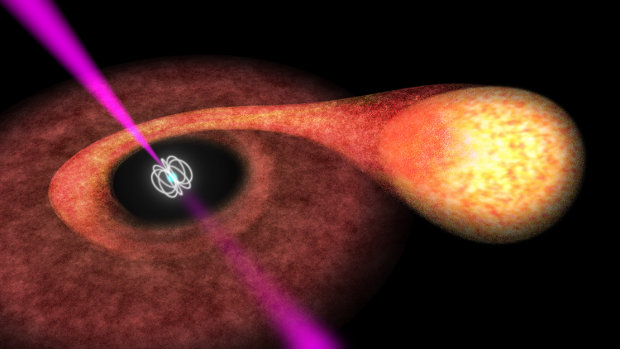
Artistic concept of a pulsar capturing materials from a companion star (Image ESA)

An international team has discovered a pulsar called IGR J18245-2452 that oscillates between two types: radio pulsars and X-ray pulsars. This is an important discovery in the study of neutron stars because it shows the evolutionary link between these two types of emissions. The discovery of this phase in the evolution of pulsars confirms a theory that’s more than thirty years old.

Image showing the life cycle of a Sun-like star from its birth to its red giant stage (Image ESO/M. Kornmesser)

An international team led by Brazilian astronomers used ESO’s Very Large Telescope (VLT) to identify and study a star almost identical to the Sun that, however, is much older. This star, called HIP 102152 and about 250 light years away from Earth, is giving astronomers a chance to see the possible future of the Sun but also to solve the mystery of its lithium content.