Stars

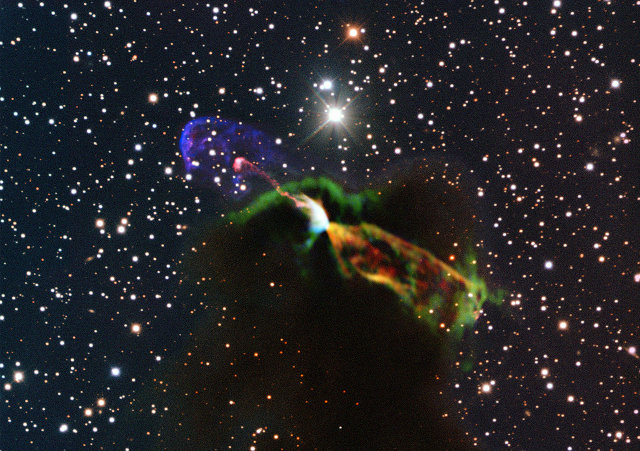
Image of Herbig-Haro 46/47 that combines observations made using ALMA and the New Technology Telescope (NTT) (Image ESO/ALMA (ESO/NAOJ/NRAO)/H. Arce. Acknowledgements: Bo Reipurth)

The ALMA (Atacama Large Millimeter/submillimeter Array) telescope has allowed to obtain extraordinary images of jets of material emitted by a newborn star. The object of this observation is called Herbig-Haro 46/47 and the analysis of the glow coming from its molecules of carbon monoxide has allowed to establish that the jets are even more energetic than expected.

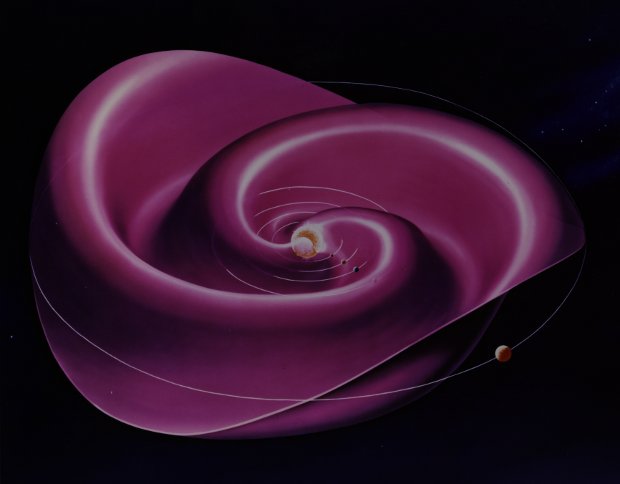
An artistic concept of the heliospheric current sheet (Image Werner Heil)

In 3 or 4 months the Sun’s magnetic field will reverse. This phenomenon is cyclical and occurs once every 11 years or so so it has nothing to do with pseudo-catastrophic prophecies. However, there will be consequences throughout the solar system but not necessarily negative.

A section of the Sun's atmosphere as seen by the SDO space probe on the left and by the IRIS space probe on the right (Image NASA/SDO/IRIS)

On June 28 there was the launch of the IRIS (Interface Region Imaging Spectrograph) space probe, a part of the Small Explorer Program which aims to explore space with probes that have a contained cost. On July 17 the great day came when the IRIS probe started sending the mages captured by its telescope and the results show that it’s already keeping its promises providing researchers with details of the lower layer of the solar atmosphere never seen before.

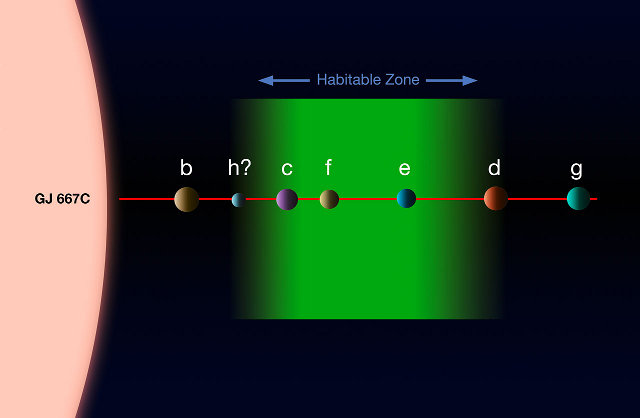
Diagrama of the planetary system of the star GJ 667C, also known as Gliese 667C (Image ESO)

The star GJ 667C (also known as Gliese 667C) rose to the spotlight a little more than a year ago, when a scientific study led to the identification of three planets and the one called GJ 667Cc was in the habitable zone of its star. Some doubt was expressed regarding this discovery but a new research, conducted by Guillem Anglada-Escudé of the University of Göttingen, Germany, and Mikko Tuomi of the University of Hertfordshire, UK, led to the conclusion that the star has at least 6 planets of which 3 in its habitable zone.