Writers

Arthur Conan Doyle in 1914 (Photo Walter Benington)

Arthur Ignatius Conan Doyle was born on May 22, 1859 in Edinburgh, Scotland. “A Study in Scarlet”, the first Sherlock Holmes novel, was published in 1887 and was a great success. 56 short stories and three more novels about the famous detective were published in the following years: “The Sign of Four” (1890), “The Hound of the Baskervilles” (1902) and “The Valley of Fear” (1915). At a certain point the author made Holmes die in the short story “The Final Problem”, which introduces his archenemy Moriarty, but the readers’ reaction convinced him to find a way to change the detective’s destiny.

The novel “The Lost World” (1912) became a classic among modern science fiction precursors. Arthur Conan Doyle re-used the character of Professor Challenger for some other novels and short stories that today can be considered science fiction.

On July 7, 1930, Arthur Conan Doyle suffered a heart attack at his country home in Windlesham. At the time of his death, the character of Sherlock Holmes had already become the protagonist of some movies and a number of short films, quickly becoming an icon far beyond literature. He’s a crucial character in the detective story / mystery genre but the author is also remembered for other important works in various genres, also often adapted in cinema and television productions.

John Scalzi in 2018

John Michael Scalzi II (photo ©Gage Skidmore) was born on May 10, 1969 in Fairfield, California, U.S.A.

John Scalzi started reading science fiction and mystery when he was a kid. He earned a bachelor in philosophy at the University of Chicago in 1991 and when he was still a student he started working as a journalist. After graduating, he worked for some years as a corporate consultant and movie critic.

In 1998 John Scalzi decided to become a full-time writer. Over the course of his career John Scalzi has explored very different themes, showing considerable versatility, so much so that he was also a consultant in the development of the TV show “Stargate Universe”. He’s now a well-established writer but he certainly still has much to offer to science fiction fans.

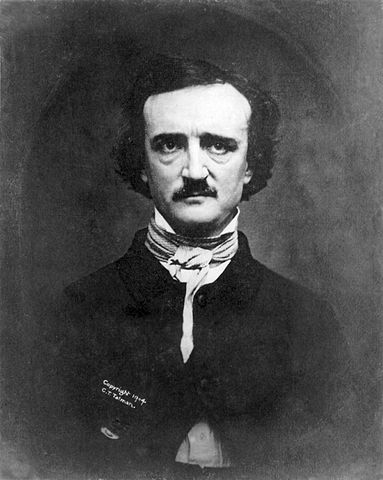
Edgar Allan Poe in 1848

Edgar Poe, this was his birth name, was born on January 19, 1809, in Boston, Massachusetts, USA.

Edgar Allan Poe’s life was complex since he was very young since his father abandoned his family in 1810 and his mother died of tuberculosis in 1811. Little Edgar was entrusted to the merchant John Allan, hence the change of his name. His new family was wealthy and had him study in Great Britain.

Initially, Edgar Allan Poe’s works were partially successful because some were successful but others received a lot of criticism. Stories that today we would call detective fiction such as “The Gold-Bug” (1843) gave him more fame in the short term than his horror stories. For the author luck was evanescent and his personal situation got worse when, in 1842, his wife Virginia started manifesting serious symptoms of tuberculosis, which got worse until her death, which occurred in 1847.

For years Edgar Allan Poe had problems with alcoholism and the last years of his life were particularly tough. His death seemed one of his stories because, on October 3, 1849, he was found in delirium in Baltimore and was taken to a hospital, where he died on October 7. The exact cause of his death is still the subject of discussion.

Philip Kindred Dick was born on December 16, 1928 in Chicago, Illinois, USA. From the beginning of his career, Philip K. Dick offered his readers stories in which the boundary between reality and appearance is very thin or even reality is anything but certain such as “Eye in the Sky” (1957), “Time Out of Joint” (1959), “The Man in the High Castle” (1962), winner of the Hugo Award, and “The Penultimate Truth” (1964). From this point of view “Ubik” (1969) represents in some ways his peak.

In the early 1980s Philip K. Dick worked on the screenplay for “Blade Runner” but died on March 2, 1982 after a stroke. At his request, he was buried next to his twin sister. After his death his fame grew noticeably with a new wave of reprints of his novels, the publication of some that had remained unpublished when he was alive and the production of movies and TV shows adapted from his works. Dick has become an object of study, also as a precursor of postmodernism, with a reputation that has long gone far beyond the science fiction genre.

Spider and Jeanne Robinson in 2004 (Photo C. A. Bridges)

Spider Robinson was born on November 24, 1948 in the Bronx, New York City, New York, USA. His career as a science fiction writer began in 1973, with the publication of the short story “The Guy with the Eyes” in the magazine “Analog Science Fiction”, the first set in a fictional universe which includes the Callahan’s Crosstime Saloon. The author wrote other stories that have that place in common: the first ones were collected in the anthology “Callahan’s Crosstime Saloon” in 1977.

The 1976 the novella “By Any Other Name” won the Hugo Award and was expanded in the novel “Telempath”, published in 1977, set in a dystopian future in which civilization is in ruins. Spider Robinson did even better with the 1977 novella, written with his wife, which won the Hugo, Nebula and Locus awards and became the first part of a novel with the same title published in 1978. In the following years the couple published the two sequels “Starseed” (1991) and “Starmind” (1995).

In 2001 Spider Robinson published “The Free Lunch”, inspired by Robert A. Heinlein’s juveniles, so much so that the title is a reference to his famous phrase “There ain’t no such thing as a free lunch”. The inspiration is even greater in his 2006 novel “Variable Star”, since it was developed from a 7-page outline for a novel written by Heinlein in 1955.