
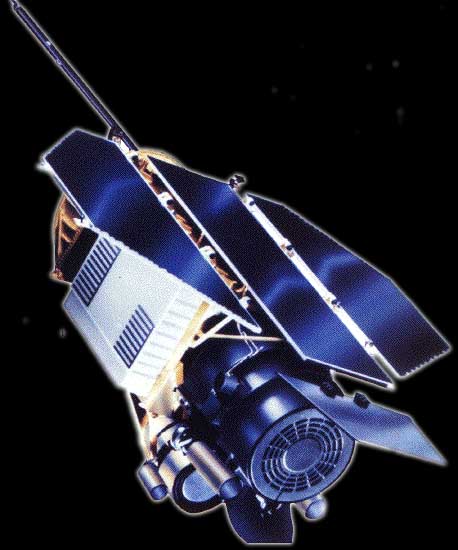
The ROSAT (Röntgensatellit, named after the X-rays discoverer Wilhelm Röntgen) satellite was a German satellite with an X-ray telescope built in collaboration with U.S.A. and U.K. for astrophysics research on black holes and neutron stars but also to survey X-ray sources in space.
ROSAT was launched on June 1, 1990 on a Delta II rocket that took off from Cape Canaveral on a mission that initially was to last 18 months with the possibility to go on up to 5 years and eventually went on for 8 years. The satellite ceased its operations on February 12, 1999 as a result of an irreversible damage suffered by its HRI (High Resolution Imager) instrument. There’s a suspicion that the damage, caused by an improper pointing of that instrument directly at the Sun, was the result of sabotage since it was connected to a cyber-attack started from Russia to the Goddard Space Flight Center with the intrusion into computers used to control various satellites. Officially however the damage to the satellite hasn’t been attributed to those intruders.
Over the years, ROSAT lost altitude until yesterday it fell into the atmosphere, as has been confirmed by various sources. As it usually happens in these cases, the satellite disintegrated into several pieces: the majority were pulverized burning in the atmosphere but it’s possible that some larger pieces reached the ground. According to assessments made, those pieces should have reached an area of south-east Asia, near the coast of Myanmar but perhaps also in China.
Almost exactly a month ago another satellite for scientific research, the Upper Atmosphere Research Satellite (UARS), crashed and it took days to establish, though without great precision, where the pieces large enough not to be pulverized fell. Now the good news is that NASA has stated that they won’t have large satellites that will fall to Earth for the next 25 years but several countries launched satellites over the years and there are thousands of pieces of debris of various sizes in orbit.
A few days ago DARPA (Defense Advanced Research Projects Agency), the U.S.A. agency that aims to develop new technologies at least initially for military use, proposed the Phoenix Program, which aims to develop technologies to revolutionize the management of satellites in orbit with a significant reduction in costs.
[ad name=”AmazonScience”]
The estimated value of satellites in geosynchronous orbit is over $300 billion. A satellite ends its usefulness as a result of a failure severe enough that it can’t be used anymore but many of its components can last for many more years. The basic idea of the Phoenix Program is to develop robots that make it possible to remove components from old satellites and reuse them.
The development of this program would lead to the creation of a new class of mini-satellites that could be sent into orbit at very low cost compared to today and there they’d be connected to recycled components. To implement such an idea several technological developments will be needed and today it looks like science fiction. On the other hand, fifty years ago the first steps of ARPANET, another project started by DARPA, had to give the same impression but that was the birth of what today is the Internet.

Permalink