
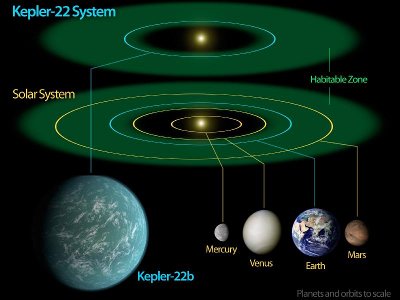
The Kepler space telescope already discovered traces of over a thousand possible planets and ten of these concern possible planets similar in size to the Earth with an orbit in the habitable zone of their star. Now confirmation arrived about one of these, called Kepler-22b, distant about six hundred light years from our solar system.
The important thing is that Kepler-22b is within the habitable zone of its star. This is the area around a star where conditions may be favorable to the development of life forms similar to ours with seas of liquid water on the surface of the planet and a potentially Earth-like atmosphere. According to preliminary estimates, if Kepler-22b had an atmosphere like Earth’s the average surface temperature should be around 22 degrees Celsius (72 degrees Fahrenheit).
The observations made by the Kepler space telescope are sent to the Science Operations Center (SOC) at NASA’s Ames Research Center in Mountain View, California, where they’re fed to NASA’s Pleiades supercomputer, one of the most powerful in the world. The analysis of that enormous amount of data allows the location of possible traces of planets that pass in front of their stars.
Given the amount of planets already discovered and the observations to be analyzed, scientists believed that it was only a matter of time before a planet similar to Earth was found. Thus came the confirmation of the discovery of Kepler-22b, a planet whose radius is about 2.4 times of the Earth orbiting a star slightly smaller and therefore a little cooler than the Sun with a year that lasts about 290 days.
[ad name=”AmazonScience”]
No word yet on whether it’s a rocky planet, gaseous or liquid but now other observatories can focus on it with various types of instruments allowing to evaluate its mass. As they already know the size of Kepler-22b, automatically they’ll have an estimate of its density, from which they can deduce the basic composition of the planet.
If the new observations of Kepler-22b were to determine that it’s a rocky planet, we could really hope that it’s similar to the Earth also concerning its surface conditions. Inevitably, then, scientists and not only them would start wondering if the planet could host life forms. This would be much more difficult to establish, also because if we sent a radio message such as: “Hello, is anybody home?” it would require six hundred years to reach its destination and as many for a possible answer.
In any case, the discovery of Kepler-22b is a milestone for astronomy and surely more Earth-like planets will be found by analyzing the observations of the Kepler space telescope. Over the past years scientific discoveries have led us to theorize the possibility of life forms in planets and even satellites outside of what was considered the habitable zone but the major candidates to host life forms and even more intelligence are still more Earth-like planets.

Permalink