
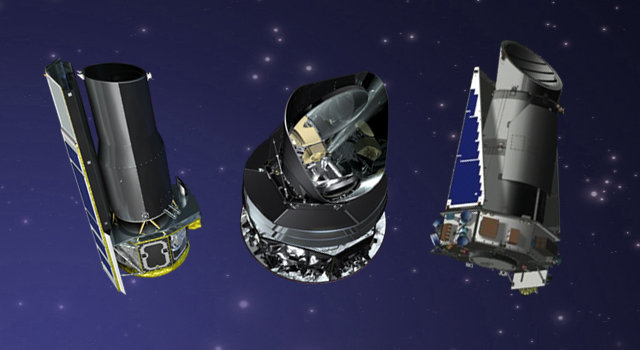
Every two years, NASA conducts an assessment of their astrophysics division missions called “Senior Review”. This year, besides a number of decisions concerning the budget of current missions, it’s been decided to extend the missions of three space telescopes: Kepler, Spitzer and Planck.
The mission of the Kepler Space Telescope received an extension until the end of fiscal year 2016, or until September 30, 2016. This decisions may be reviewed in the 2014 Senior Review but for now an extension has been granted.
The Kepler Space Telescope was launched on March 7, 2009 on a Delta II rocket and started its operations almost exactly a month later. It was named after astronomer Johannes Kepler and its mission is to study the stars of the Milky Way to discover which of them have planets, in particular how many stars have planets similar to Earth.
So far, the Kepler Space Telescope has found more than 2,000 candidates which are slowly studied with other instruments to verify if the planets really exist. For example, in December 2011, the planet Kepler-22b was discovered, a planet that could be very similar to Earth. The confirmations of the existence of planets in other star systems no longer make the news.
The mission of the Spitzer Space Telescope received an extension of two years and in 2014, at the next Senior Review, they will assess if to extend it again.
[ad name=”AmazonDocumentary”]
The Spitzer Space Telescope was launched on August 25, 2003 on a Delta II rocket. Initially called the Space Infrared Telescope Facility (SIRTF), on December 18, 2003 the name was officially changed to honor astrophysicist Lyman Spitzer, who among other things was the first to propose the construction of a space telescope.
The initial mission of the Spitzer Space Telescope was to last two and a half years but it was extended. In 2009, the supplied liquid helium was exhausted so some instruments that required extremely low temperatures ceased to function. However, other instruments are still active so what is called the “Warm Spitzer Mission” can continue.
The Spitzer Space Telescope keeps on providing infrared images studying extrasolar planets, stars and galaxies.
The Planck Space Telescope is an ESA mission with a NASA participation. An additional year of funding was decided for this mission.
The Planck Space Telescope was launched on May 14, 2009 on an Ariane 5 rocket and started its operations on August 13, 2009. It was named after physicist Max Planck. Its mission has a lot of scientific objectives, including measuring the cosmic background radiation, testing the model of cosmic inflation, estimating the cosmological parameters, studying clusters of galaxies and the interstellar medium of the Milky Way.
All these missions have already produced interesting results, therefore it’s very positive achivement that they were extended. In a time when budgets are appropriately evaluated with care, it’s money well spent.
