
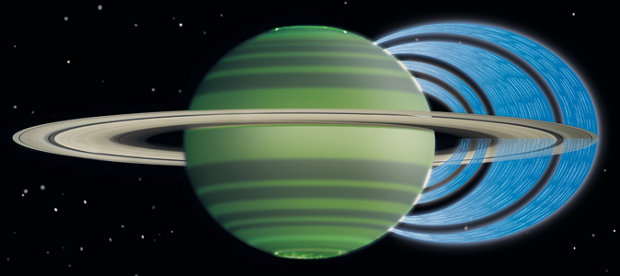
In an article published on “Nature”, a team of scientists led by James O’Donoghue, University of Leicester, England, explains how a rain of charged particles from Saturn’s rings falls on the planet in much greater quantities and on a much wider area than previously thought.
This phenomenon was already known since it was discovered in the early ’80s by the Voyager spacecraft, which showed two to three dark bands on Saturn. The scientists hypothesized that water was falling on the planet from the rings. Those bands were no longer seen until the team led by O’Donoghue studied Saturn observing near-infrared wavelengths using the Keck Observatory on Mauna Kea, Hawaii.
This new observation was made possible thanks to NIRSPEC, a spectrometer capable of working with near-infrared wavelengths and to split up a wide range of light emissions allowing to observe the subtle emission from the luminous parts of Saturn.
It was possible to discover that sometimes the tiny ice particles that make up the rings are eroded and deposited in the upper atmosphere of Saturn, causing the rain. It’s the first planet where a significant interaction between the atmosphere and the rings was observed. In this case, the rain would greatly reduces the density of electrons in the regions where it falls.
This effect, at first sight trivial, is actually one of the fundamental effects that drive the environment in the ionosphere of Saturn and the planet’s climate. The particles of the rings at an altitude of about 60,000 km (about 36,000 miles) affect both the types of particles in that part of the atmosphere and the areas in which it’s hot or cold.
The rain coming from the rings falls in the ionosphere and there the otherwise neutral environment is exposed to a flux of energetic particles or solar radiation and charged particles are created as a consequence. When the scientists tracked the pattern of emissions of a hydrogen ion with three protons, they expected to see an infrared light evenly over the planet. Instead, they found a series of bands of light and dark, with areas of reduced emissions corresponding to the water-dense portions of Saturn’s rings and areas of high emissions corresponding to the gaps in the rings.
Now the researchers are hoping to continue their investigation using the Cassini spacecraft, which has been exploring the Saturn system since 2004. It won’t be easy because there are so many requests for its use but it would be the ideal solution to get more details in the observations of the interactions between water and Saturn’s atmosphere.
Probably that’s not a type of research that will bring results that can change our lives but once again it demonstrates the surprises that can be found in the Saturn’s system.
[ad name=”AmazonDocumentary”]
