October 2013

François Englert and Peter Higgs (Photo courtesy CERN. All rights reserved)

When last year two experiments at CERN, CMS (Compact Muon Solenoid) and ATLAS (A Toroidal LHC Apparatus), announced the preliminary results of their research confirming the existence of the Higgs boson, everybody started expecting Peter Higgs to receive the Nobel Prize for physics. Today came the official announcement of the award to him and François Englert, the other physicist who in the ’60s published an independent work that led to very similar conclusions.

About two weeks ago, the news came that a consortium led by the Canadian financial company Fairfax Financial had offered $4.7 billion to buy BlackBerry Limited. The smartphone maker only signed a letter of intent that allows the company to deal with other possible buyers and there are rumors of other potential offers. However, the news came of a lawsuit filed by a shareholder that could further complicate the situation.

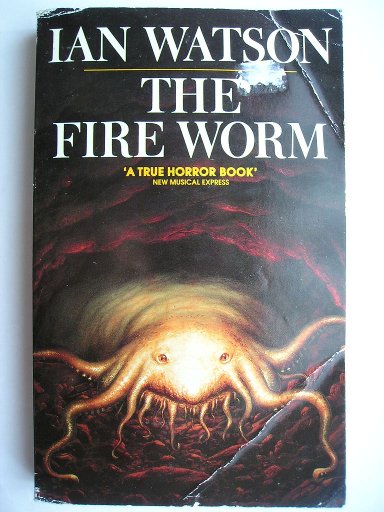
The Fire Worm by Ian Watson

The novel “The Fire Worm” by Ian Watson was published for the first time in 1988.

John Cunningham is a psychiatrist who has a kind of double life in which his alter-ego Jack Cannon is a horror writer. To maintain his medical reputation, he reveals no information about his true identity, not even to his publisher. However, his second identity is to him like a second personality.

Artist impression of a protostar in the Infrared Dark Cloud MM3 (Image Courtesy of the National Astronomical Observatory of Japan. All rights reserved)

An international team led by Takeshi Sakai of the University of Electro-Communication, Japan, used the ALMA (Atacama Large Millimeter/submillimeter Array) radiotelescope to study a newborn star. Known only as G34.43+00.24 MM3 or more simply as MM3, this star is so young that it’s still surrounded by a huge cocoon of gas, a cloud about ten times larger than any other observed around stars of solar mass.

The Eden Patera crater on Mars (Image ESA)

According to a research conducted by Joseph R. Michalski of the Planetary Science Institute and Jacob E. Bleacher of NASA’s Goddard Space Flight Center just published in the journal “Nature”, a crater on Mars wasn’t created by an impact but is what remains of an ancient supervolcano.