
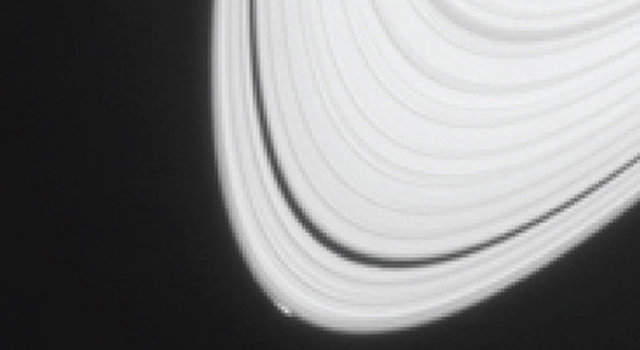
The Cassini space probe has detected an object at the edge of the planet Saturn’s outermost ring, the one called ring A, that could be a new moon. Informally called Peggy, it may be just forming, a small block of ice with a diameter of less than one kilometer (about half a mile) detectable only by the slight gravitational disturbance that caused on the ring.
The photograph that shows the perturbation on the outer edge of Saturn’s ring was taken almost exactly a year ago, on April 15, 2013. Specifically, this disturbance is an arc 20% brighter than the area that surrounds it. The scientists also found an unusual protuberance in the profile generally smooth of the ring’s edge.
These abnormalities have been attributed to an object present in the area that causes a disturbance with its force of gravity. The details of the observations were published on April 14, 2014 in the journal “Icarus”. Those are indirect observations because the object is too small to be studied directly.
The formation of this possible moon may seem a really trivial matter but it’s a phenomenon never seen before. Many of Saturn’s moons are composed mostly of ice, just like the particles that make up the rings. According to one theory, the moons were formed from those ring particles then moved away from the planet, sometimes merging with other moons. Peggy could give scientists the opportunity to test this theory.
Probably in the past Saturn’s rings were even more massive therefore contained enough material to form some moons. Today, as majestic as they still are, they have enough material to create only small objects such as Peggy. Probably, this tiny moon won’t grow anymore and may even fall to pieces, too small to be stable. Other objects of detectable mass are unlikely to form.
Peggy is an icy object but the mechanism of its creation is also valid for the dust disk that existed at the dawn of the solar system. The planets may have formed in a similar manner to Peggy from that disk, another reason why astronomers are trying to get all the information they can. The Cassini spacecraft will approach the outer edges of Saturn’s rings near the end of 2016. This will give astronomers an opportunity to study the area more closely and maybe even to directly observe Peggy.
[ad name=”eBayUSUKAstronomy”]
