
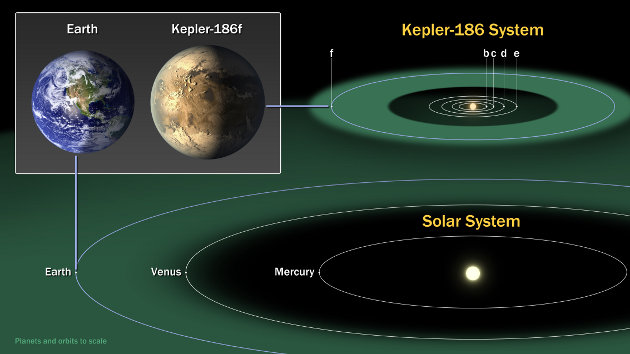
NASA has announced the discovery of Kepler-186f, a planet that is about 10% larger than the Earth and is in the habitable zone of its solar system. It is very likely a rocky planet, which means that it’s the most similar to Earth found so far. With those characteristics, it could host liquid water and have the conditions for the emergence of life forms.
The planet Kepler-186f is part of the star system of the Kepler-186 star, a red dwarf about 500 light years from Earth. The mass of this star is about half of the Sun, which means that it’s colder than our star. For this reason, the planet Kepler-186f is considered to be potentially habitable even if its distance from its star is similar to that of Mercury from the Sun with a year that lasts about 130 Earth days.
The star system Kepler-186 had already been the subject of observations by the Kepler space telescope. The presence of four other planets had already been established, other rocky planets with a size of less than one and a half times the Earth. The problem is that those planets are very close to their stars so even if it’s small and relatively cool they are still too hot to host life forms of a type known to us.
The planet Kepler-186f is the best candidate to host life forms found so far, so much that the announcement of his discovery was hyped by NASA. This is understandable considering that the characteristics of this planet are objectively interesting and the American space agency is increasingly looking for praises to avoid further budget cuts. The hype reached media with very strong statements on this planet but is it really so similar to Earth?
Actually, the observations of the planet Kepler-186f are indirect and at least for now it will be impossible to observe it directly because it’s too close to its star for the existing instruments. Its size has been established with a good approximation but its mass and composition are yet to be assessed. These characteristics are essential to understanding how much it’s truly Earthlike.
The presence or absence of an atmosphere and its possible composition and density are another crucial factor in the evaluation of a planet and in this case at the moment we know nothing about the planet Kepler-186f. In short, this is a really interesting discovery but there’s still much to learn about this planet to understand if it can really host life forms similar to those on Earth.
What is certain is that the interest raised by this discovery will make scientists try new observations with other telescopes. In a few years, when finally the James Webb Space Telescope gets launched, the planet Kepler-186f could be one of its first research targets.
[ad name=”AmazonDocumentary”]

Permalink