
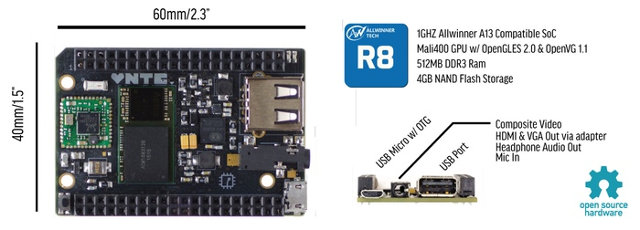
In recent years the range of really tiny and very cheap computers has increased tremendously. A few days ago, a fundraiser started for one of these called C.H.I.P. that immediately had an incredible success. Next Thing Co. is a company based in Oakland, California, USA, which aims to offer a PC for just $9. To do this it needed to raise $50,000 and while I’m writing $943.501 were already pledged. The fundraiser will continue until June 6, 2015.
This tiny PC 6 cm (2.3″) long and 4 cm (1.5″) wide is based on the Allwinner R8 SoC (system on a chip, a chip that contains a complete basic system) with a Cortex-A8 CPU and a Mali-400 GPU, an advanced version of the A13 SoC. Inevitably, the amount of memory is limited and precisely it’s 512 MB of DDR3 RAM and 4 GB of mass storage of the flash type.
As for the I/O, the C.H.I.P. is equipped with a USB and a micro-USB port and a composite video jack. It also has hardware support for Wireless 802.11b/g/n and Bluetooth 4.0 connections. The operating system is of course Linux, precisely Debian. The hardware is open source as well.
The comparison with the Raspberry Pi is inevitable. The C.H.I.P. hardware is close to that of the first Raspberry Pi version, released a little over three years ago with great success. The success of that project opened the doors to others and now the C.H.I.P. promises to be a real PC, despite its limitations.
Next Thing Co. also offers various accessories for the people who want something extra. You can buy it with a battery to makes C.H.I.P. portable. You can buy adapters for VGA or HDMI video connections. An additional project is the PocketC.H.I.P. to turn C.H.I.P. in a tiny netbook with a 4.3″ touchscreen and wgain it’s open source hardware.
The kernel hackers will participate in the software development and receive the C.H.I.P.s and a PocketC.H.I.P. in September 2015. The other backers will receive the products starting from December 2015 until mid-2016, depending on what accessories they pre-ordered. This is not a PC of the kind used by common users daily for work or entertainment but the success of the Raspberry Pi, the Arduino boards and other hardware of that kind shows that there is a growing demand for these computers.
The C.H.I.P. may be fine for common uses but can be a perfect solution especially for hacking, for educational purposes and to develop projects that require very small and inexpensive hardware. There’s much hype around the Internet of Things but the growth of applications in the home automation field is real and products such as C.H.I.P. can be ideal to develop them.
