
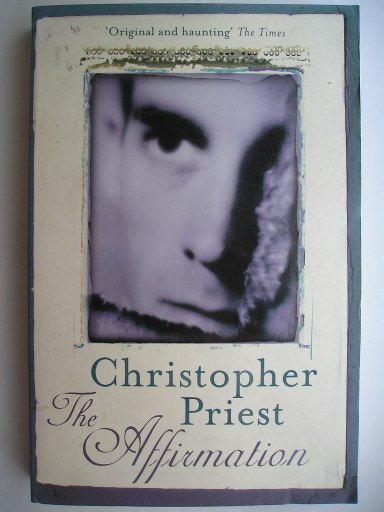
The novel “The Affirmation” by Christopher Priest was published for the first time in 1981. It won the Ditmar Award. It belongs to the Dream Archipelago series.
Peter Sinclair is in a very bad moment of his life when in a short time he loses his job and comes out of a very complicated love story. He needs to find himself and agrees to do some maintenance work at the cottage of an acquaintance to be able to isolate himself. He starts to write an autobiography but his mind begins to get lost in another world where he lives another life.
Peter Sinclair has won the lottery and the prize is a treatment that will ensure his potential immortality. However, he’ll have to start his life again because the treatment involves the loss of memory. He must write his memoirs to get them back but his identity begins to mix with that of the other Peter Sinclair.
“The Affirmation” is considered by Christopher Priest a key novel in his career: In his opinion, the previous ones led to it and the following ones have been written thanks to it. It received mixed reactions so it won the Ditmar Award in Australia and was nominated for the British BSFA Award but also received negative reviews.
Today we’re probably more accustomed to the kind of story told in “The Affirmation”, in early ’80s it must have confused many readers. The difficulty to put it simply into a specific genre may have contributed to the confusion. It participated in awards in the field of science fiction and as such is generally labeled but maybe it’s more a postmodern novel. It’s one of cases in which the label is limiting.
At first, the story seems merely relate to the problems of an ordinary person. Peter Sinclair is in a particularly difficult period of his life after he lost his job and by the end of a love affair. Having to rely on the help of his sister and his brother in law is a burden and when he has the opportunity to live in an acquaintance’s cottage i’is an opportunity for him to find himself.
Everything changes when Peter Sinclair starts writing an autobiography which, however, turns out to be the story of another man, his alter-ego who lives in another world, in the Dream Archipelago. At that point, an obsession starts for what has become the biography of the other Peter Sinclair and this leads to a progressive confusion in his identity.
This brings us to the story of the Dream Archipelago’s Peter Sinclair. In his case, there’s a physical journey to the place where he can receive the treatment that will give him potential immortality and at the same time an inner journey because the treatment involves the loss of memory, making the change even bigger.
That Peter Sinclair has many doubts about the treatment, too many in my opinion considering that we’re talking about immortality against the loss of a few decades of memories. Of course, that’s all the life he lived up to that point but the gain far outweighs the loss.
This double life is told by Peter Sinclair in the first person making it a story of deep psychological insight. The complexity is given by the protagonist’s state of mind, split in two persons with the gradual confusion of their identity.
For this reason, “The Affirmation” is basically a journey into the protagonist’s mind with a typical pace of a story of that kind, which is slow. The other characters are seen from Peter Sinclair’s perspective and mostly contribute to deepen our knowledge about him.
For example, the English Peter’s sister allows us to understand more about him thanks to the contrasts that exist between them. However, his point of view influences his opinion so much that the reader can’t understand if the woman is really like is described by his brother.
On the other hand, elements like this one make it clear to the readers that Peter Sinclair is an unreliable narrator. Considering the kind of story he tells, that makes it even more difficult to figure out which parts of his story we can believe and which ones we should be skeptical of.
“The Affirmation” is a novel I found intriguing for the mental journey between the worlds of the two Peter Sinclairs with all its nuances and its ambiguities. Because of these characteristics, I recommend it to people who enjoy stories with a profound psychological component, regardless of the labels that can be attached to it.

Permalink