
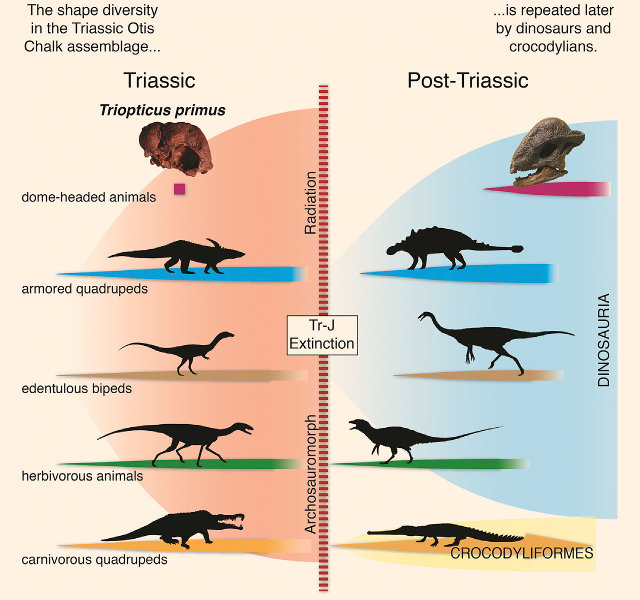
An article published in the journal “Current Biology” describes a research on a species of reptile that was called Triopticus primus. A group of paleontologists led by Michelle Stocker of Virginia Tech College of Science studied this reptile that lived about 230 million years ago, noting several features similar to those of pachycephalosaur dinosaurs that lived 100 million years later. The research also revealed other similarities between animals contemporary to Triopticus primus and dinosaurs that lived millions of years later.
After the devastating extinction occurred about 250 million years ago, at the end of the Permian period, reptiles began a remarkable diversification. Among them, the large group known as archosauromorphs showed a remarkable diversity of fossils but this new research also noted cases of convergent evolution. Essentially, distantly related animals evolved until they had some very similar characteristics.
In Otis Chalk, Texas, fossils of vertebrates of the late Triassic period were discovered. Over the past few decades many new species of fish, amphibians and reptiles were discovered providing a picture of remarkable quality of that geological period. Triopticus primus was only one of the reptiles discovered because other species were found along with it and they also showed similarities with dinosaurs that lived many millions of years later.
Essentially, the researchers found that these reptiles’ body shapes are the same taken many millions of years later by various species of dinosaurs. The long snouts of Spinosaurus, the toothless beaks of ornithomimids, and the armor plates of ankylosaurs existed in animals that lived in an earlier geological period.
The various evolutionary convergences were also studied by examining the fossils with X-ray CT scans. They allowed to go beyond the superficial similarities and study for example those in the bone structure of the skulls and even brains of Triopticus primus and pachycephalosaurs.
Evolutionary convergences have already been studied in various research and yet these new examples are surprising. The reptiles and the dinosaurs that lived many millions of years later are distant relatives and it’s really rare to discover so many different species belonging to an ecosystem and other species with similar characteristics many millions of years later. This discovery was made possible thanks to the exam of fossils that remained in a collection of ancient bones for 70 years, a demonstration that specimens in theory already known can still hold surprises.

Permalink