 An article published in the journal “Scientific Reports” reports the discovery of two new specimens of Eretmorhipis carrolldongi, a marine reptile that lived about 250 million years ago, in the Early Triassic period, in today’s China. A team of researchers studied these new specimens with particular interest because of the previous ones one had its skull but it was in a poor state of conservation and the other one had no skull. The new specimens show that this reptile had similarities with modern platypuses, with a sort of bill of cartilage and receptors that allowed it to hunt based on touch.
Eretmorhipis carrolldongi was identified only in a research published in the journal “PLoS ONE” in May 2015 thanks to the discovery of a second specimen because the first, discovered in 1991 by Robert L. Carroll and Zhi-ming Dong, was in a poor state of conservation. This species was classified in the order of the hupehsuchians (Hupehsuchia), relatives of the ichthyosaurs that have in common the fact that they lived in the Early Triassic in today’s China.
The team that studied the two new specimens of Eretmorhipis carrolldongi includes most of the researchers who identified and named this species. The possibility of studying the skulls of these reptiles allowed them to better understand these reptiles’ characteristics and some evolutionary convergence in common with modern platypuses.
250 million years ago in the area where Eretmorhipis carrolldongi lived there was a shallow sea, about a meter, above a carbonate platform that stretched for hundreds of kilometers. This reptile’s fossils have been found in deeper holes in the platform. No fossils were found nearby that could indicate what they were feeding on, but according to Professor Ryosuke Motani, a paleontologist at the University of California, Davis, their food consisted of small invertebrates.
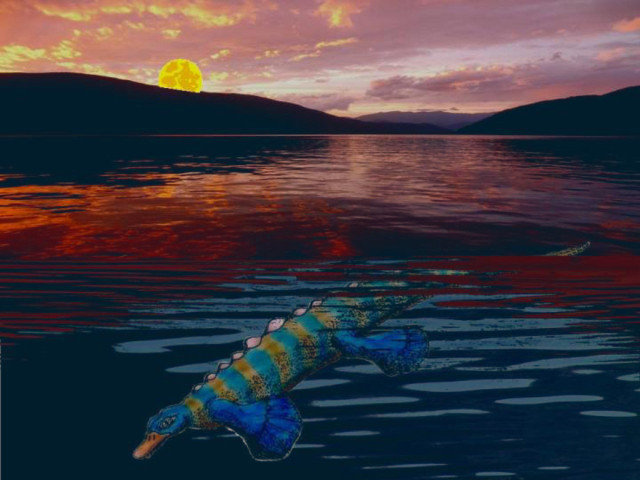
The body of Eretmorhipis carrolldongi was about 70 centimeters long and bony and probably it was a poor swimmer. It had a small head with tiny eyes that suggested it had poor eyesight. The similarities with the platypus, with a bill of cartilage and a hole in the middle, suggest that it had receptors that allowed it to use touch to hunt for small invertebrates in the mud in conditions where there was little light.
The top image (L. Cheng et al., Scientific Reports, Creative Commons 4.0) shows the fossil of one of the new specimens of Eretmorhipis carrolldongi and a drawing of his skeleton. The bottom image (Courtesy Gianluca Danini, all rights reserved.) shows an artistic reconstruction of this marine reptile.
Eretmorhipis carrolldongi had characteristics that arouse curiosity but is also interesting from a scientific point of view because it shows one of the branches of marine reptiles’ evolution at the beginning of the Triassic period. The diversification of these animals during that period is the subject of discussion among paleontologists and the various species of hupehsuchians discovered in recent decades show more and more how fast it was already in its initial part.