January 2019

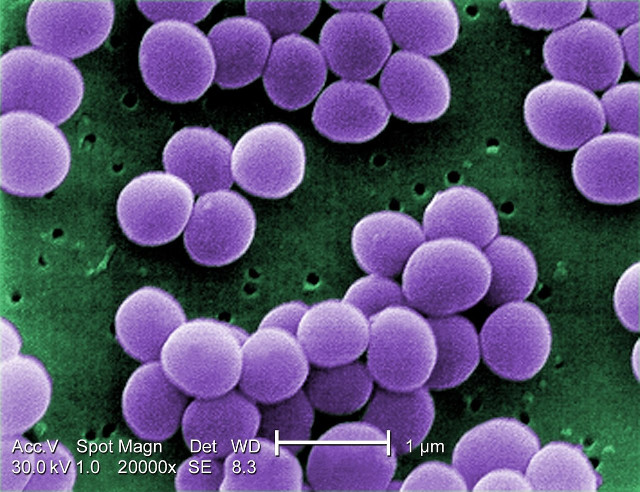
Staphylococcus aureus (Image Centers for Disease Control and Prevention's Public Health Image Library (PHIL))

An article published in the journal “mSystems” describes a research on the adaptations of bacteria of the species Bacillus cereus and Staphylococcus aureus found on the International Space Station. A team of researchers led by Erica Hartmann of Northwestern University compared 189 genomes isolated from various origins to understand the influence of what are called built environments, human products that modify the natural environment. In the Station’s case, it’s an extreme environment and yet no dangerous mutations were detected such as resistance to antibiotics but they developed adaptations to difficult conditions.

Protoichthyosaurus prostaxalis during a CT-scan (Photo courtesy University of Manchester. All rights reserved)

An article published in the journal “PeerJ” describes the examination of the specimen of a marine reptile that lived during the Jurassic period, about 200 million years ago. A team of researchers submitted it to an advanced CT-scan that allowed to examine it in depth and to conclude that it belongs to the species Protoichthyosaurus prostaxalis while originally it was identified as a specimen of Ichthyosaurus communis.

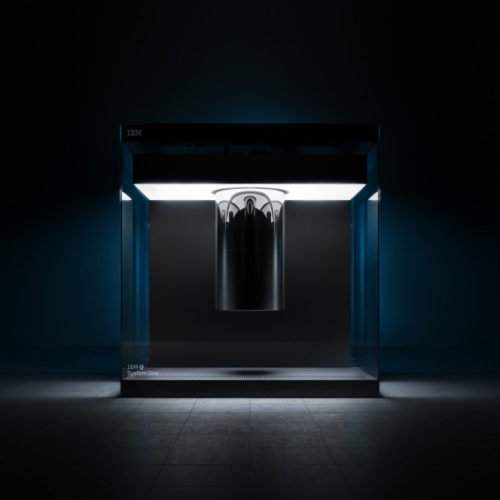
IBM Q System One (Photo courtesy International Business Machines Corporation. All rights reserved)

At CES, IBM announced its first commercial 20-qubit quantum computer called IBM Q System One and the IBM Q Quantum Computation Center for its business customers. For some years IBM has been developing its own IBM Q quantum systems, also thanks to tests conducted allowing its customers the access to them via cloud and offering the possibility to develop specific applications, now the company has announced a system declaring a reliability comparable to that of a classic mainframe.

The Fortress in Orion by Mike Resnick

The novel “The Fortress in Orion” by Mike Resnick was published for the first time in 2014. It’s the first novel in the Dead Enders series.

Colonel Nathan Pretorius is entrusted with the most difficult secret missions behind enemy lines and at the end of the last one he died for a few minutes before the doctors managed to bring him back to life. For this reason, he no longer wants to be involved in more missions on behalf of the Democracy but General Cooper finds a way to convince him to lead a very important mission for the fate of the war against the Transkei Coalition.

The Democracy has managed to grow a clone of Michkag, a key General in the Transkei Coalition: being able to replace the real one would mean allowing him to influence their enemies to positions more oriented towards a peace treaty. Michkag is constantly under protection and Nathan Pretorius chooses a group of unlikely heroes to infiltrate the fortress on Orion to proceed with the replacement.

Unmodified plants (left) grow beside modified plants (right) (Photo courtesy Claire Benjamin/RIPE Project)

An article published in the journal “Science” reports the experimentation of the use of a genetic technique to increase the efficiency of plant photosynthesis. A team of researchers led by the molecular biologist Paul South of the US Agricultural Research Service carried out this experimentation within the Realizing Increased Photosynthetic Efficiency (RIPE) project, which has exactly this purpose to improve the sustainability of agricultural crops and increase land productivity. Modified plants increased their growth by 40%.