An article published in the journal “Nature Communications” reports evidence of an abundance of carbon dioxide in basaltic rocks dating back to the end of the Triassic period, just over 200 million years ago, of what is called the Central Atlantic Magmatic Province (CAMP). A team of researchers discovered carbon dioxide bubbles still imprisoned in those ancient volcanic rocks, evidence that supports the theory that volcanic activity contributed to the climate changes that caused the mass extinction. That type of emissions has similarities with what we’re seeing today, so the study of very ancient events can give us an idea of what could happen in the near future.
The Central Atlantic Magmatic Province is a large igneous province and this means that it’s made up of huge accumulations of magmatic rocks that came out of the Earth’s crust. This one in particular was formed in the then Pangea following a large-scale volcanic activity that took place in various stages over a period of more than half a million years between the end of the Triassic period and the beginning of the Jurassic period, just over 200 million years ago. Today the remains of that province are divided into various continents.
The mass extinction that occurred at the end of the Triassic period is one of the five major extinctions that occurred in the history of life on Earth. Compared to other major extinctions, the causes continued to be the subject of discussions, but for some years various studies have been focusing on the eruptions of the Central Atlantic Magmatic Province, dating back to that time. Such intense and prolonged activity could have led to the emission of considerable amounts not only of ashes and lava but also of carbon dioxide. A greenhouse effect might have been triggered and brought to the point of altering the climate globally until it destabilized many ecosystems.
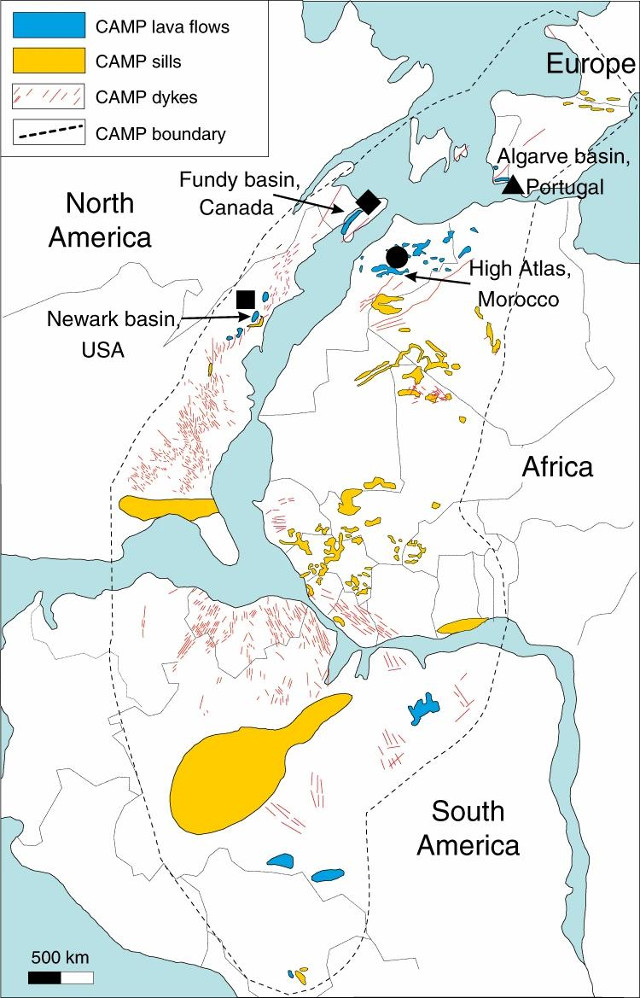
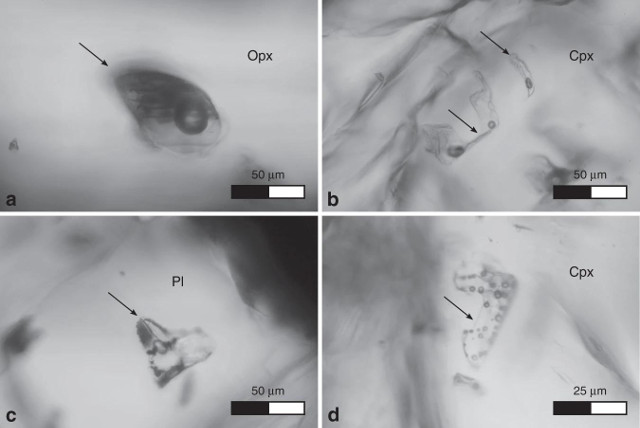
Over 200 basaltic lava samples from the Central Atlantic magmatic province were collected in flows and sills remains in North America in the USA and Canada, in Africa in Morocco, and in Europe in Portugal. The researchers found carbon dioxide bubbles in abundance with features suggesting that the eruptions were very rapid and potentially catastrophic for the climate and biosphere.
The top image (Courtesy Capriolo, M., Marzoli, A., Aradi, L.E. et al.) shows some samples containing air bubbles. (a) Single-bubble hosted in orthopyroxene (Nova Scotia, Canada). (b) Single- and multi-bubble, with very irregular shapes, hosted in augitic clinopyroxene (Morocco). (c) Multi-bubble, partially crystallized (containing also opaque mineral phases), hosted in calcic plagioclase (Nova Scotia, Canada). (d) Multi-bubble hosted in augitic clinopyroxene (Nova Scotia, Canada).
The bottom image (Courtesy Capriolo, M., Marzoli, A., Aradi, L.E. et al.) shows the map of the Central Atlantic Magmatic Province at the time of Pangea, about 200 million years ago. In blue the positions of the lava flows are shown, in yellow those of the sills, with the red dashes those of the dykes.
Despite the number of samples taken, it’s not possible to accurately determine the amount of carbon dioxide that was released into the atmosphere by the various eruptions that occurred in that long period. Approximate estimates suggest that the emissions during one of the various phases of volcanic activity were comparable to those produced by human activity projected for the 21st century. This indicates that those emissions were sufficient to generate a global warming that also triggered other problems such as ocean acidification. In essence, a confirmation of the link between that volcanic activity and the mass extinction of the end of the Triassic and a warning for what’s happening to the environment today.