May 2020

Gravitational lens candedates

An article published in “The Astrophysical Journal” reports the identifications of 335 new gravitational lens candidates discovered using machine learning software trained for this task. A team of astrophysicists led by Xiaosheng Huang of the University of San Francisco submitted images from the DECaLS investigation obtaining 335 possible gravitational lenses so far unknown. The verification will be carried out by humans, and 60 candidates have been included in the group that has the most chances of being confirmed. Gravitational lenses help astronomers in observing very far objects behind them, so the more are known the more likely they can be useful in some research.

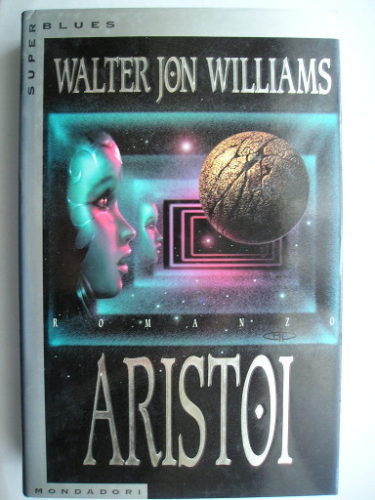
Aristoi by Walter Jon Williams

The novel “Aristoi” by Walter Jon Williams was published for the first time in 1992.

Gabriel is an Aristos engaged above all in the fields of architecture and music running various planets whose activity is focused on the arts. He is helped by various dáimones, limited personalities who deal with specific activities. Not all the Aristoi are satisfied with the situation and some of them would like to return to the adventurous past that forged their society, but Gabriel is part of the majority who believe that such a past was too chaotic and dangerous.

When Cressida, an Aristos who works in the science field, discovers that someone violated the Hyperlogos, which contains all the knowledge of the Logarchy, she investigates and discovers that something very strange is happening in an area of ​​space that’s supposed to have been devastated by a supernova. She confides in Gabriel, the Aristos closest to that area, just before she gets killed in the destruction of her laboratory. Gabriel, convinced that it wasn’t an accident, realizes that he must investigate in secret a possible threat to the entire Logarchy.

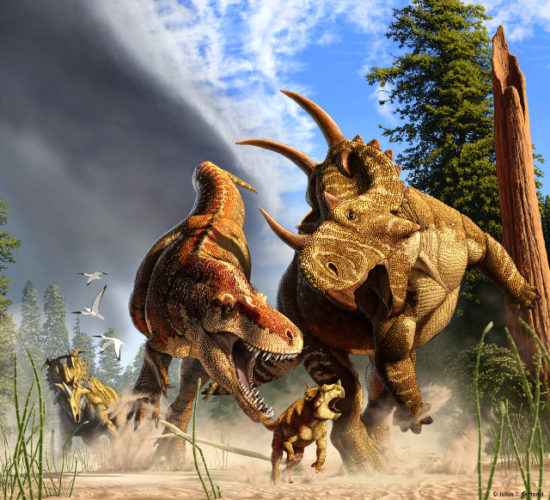
A Daspletosaurus chasing Spinops (Image courtesy Julius Csotonyi)

An article published in the journal “PLOS ONE” reports a study on the locomotion capabilities of the dinosaurs of the theropod group, and in particular of more than 70 species belonging to the carnivorous groups Tyrannosauridae, which includes T. rex, Allosauroidea and Ceratosauridae. A team of researchers considered various physical characteristics to evaluate the allometry impact on those dinosaurs’ ability to run and the limiting effect of their size, aspects that are generally overlooked. One conclusion is that large predators such as T. rex had the advantage of efficiency thanks to their long legs, not of speed as previously thought.

The Man Who Sold The Moon by Cory Doctorow (Italian edition)

The novella “The Man Who Sold The Moon” by Cory Doctorow was published for the first time in 2014.

Greg Harrison has just received the result of a medical test that turned out negative. When he’s still shaken by having dodged a cancer, he accidentally runs into a young man who calls himself Pug, and he discovers they share some interests. Pug has built a 3D printer that uses sand to build bricks to assemble a yurt, and when he’s diagnosed with an incurable cancer, Greg decides to launch a version of it to the Moon, where it could use ground dust as a building material.

Bruce Boxleitner in 2011

Bruce William Boxleitner was born on May 12, 1950, in Elgin, Illinois, USA. Bruce Boxleitner began working on television productions while roles in film productions were rare in the 1970s. Fame came to him playing Luke Macahan in the TV show “How the West Was Won”, which aired between 1976 and 1979. In the 1990s, what perhaps is the role for which he’s best known, John Sheridan in the TV show “Babylon 5”, arrived for Bruce Boxleitner. The actor was a regular character in the show from the second to the fifth and last season, between 1994 and 1998. He reprised that role in the following years in some TV movies connected to it that are set in different periods before, during, and after the show.