June 2020

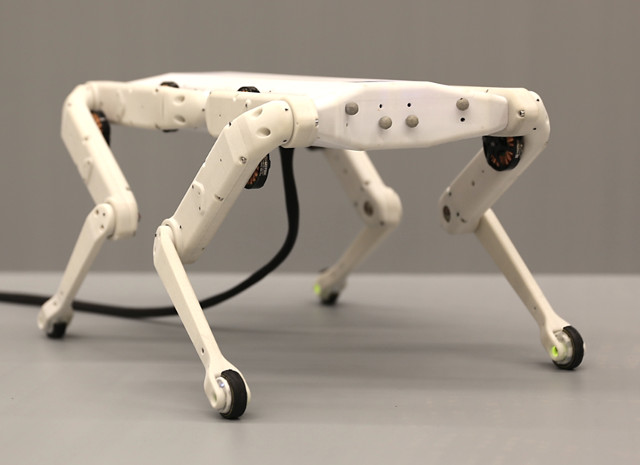
The Solo 8 robot (Photo courtesy Open Dynamic Robot Initiative)

An article accepted for publication in the journal “Robotics and Automation Letters” describes the design of a low-cost quadruped robot made available on GitHub under the free / open source BSD 3-clause license having been developed under the aegis of the Open Dynamic Robot Initiative. A team of researchers led by Ludovic Righetti of the Max Planck Institute for Intelligent Systems (MPI-IS) in Tübingen and Stuttgart, Germany, designed the robot Solo 8 using components such as torque control motors and actuators available in stores and components with 3D printing instructions available with the project. This made it possible to build a Solo 8 at a component cost of around € 4,000, still high, but less than a tenth of other robots with equivalent capabilities in performing sophisticated actions. The free license will allow others to further develop the project.

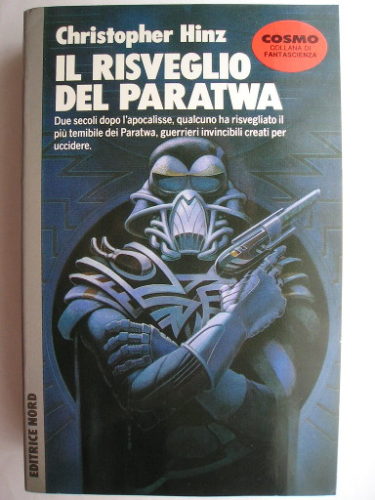
Liege-Killer by Christopher Hinz (Italian edition)

The novel “Liege-Killer” by Christopher Hinz was published for the first time in 1987. It’s the first book of the Paratwa series.

When Paula and her son Jerem witness a brutal murder, it’s immediately clear from the way it was committed that the perpetrator is not a common murderer. Two centuries after the catastrophe that devastated the Earth, on the orbital colonies the memory of the terrible Paratwa killers has become a legend. More brutal murders confirm that a Paratwa is back in action.

Rome Franco, director of E-Tech, the organization that monitors technological advances to prevent them from threatening humanity, hopes to find in the archives dating back to the times when E-Tech fought the Paratwa something useful for the new situation. Documents about a cryogenic stasis capsule are found, and two people turn out to be there, Nick and Gillian, who could represent hope against the Paratwa.

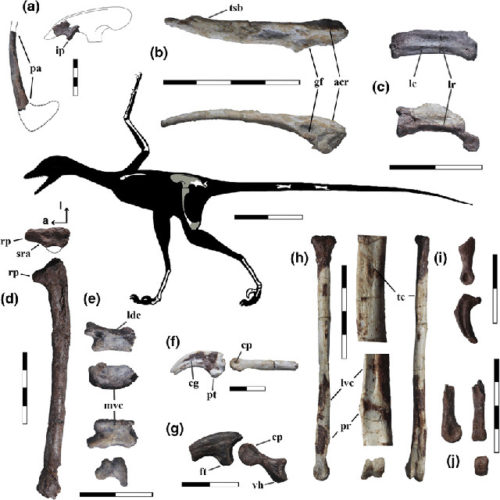
Silhouette of Overoraptor chimentoi with the bones found

An article published in the journal “Science of Nature” reports the identification of a new species of dinosaur with characteristics similar to birds that lived about 90 million years ago, in the Cretaceous period, in today’s Patagonia, Argentina. A team of researchers led by Matias Motta named it Overoraptor chimentoi, a name that reminds more of predatory dinosaurs than birds. In fact, some of its characteristics are typical of that type of dinosaur, with legs suitable for running and a claw similar to that of Velociraptor on its second toe. Instead, its arms have characteristics much closer to bird wings, and this suggests that it’s one of the species closest to birds among the various known raptors.

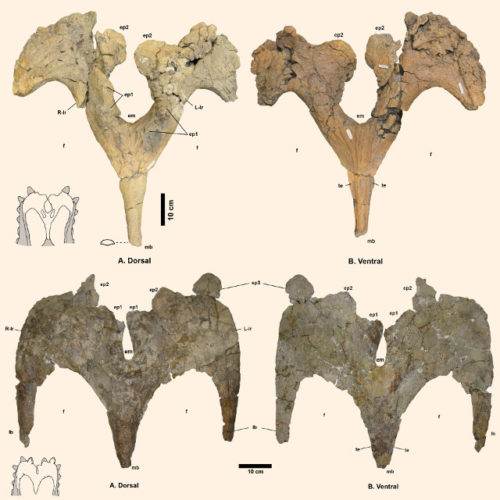
Bones of Navajoceratops sullivani and Terminocavus sealeyi

An article published in the journal “PeerJ” reports the discovery of two species of horned dinosaurs that lived about 75 million years ago, in the Cretaceous period, in today’s New Mexico, USA. Dr. Denver W. Fowler and Dr. Elizabeth A. Freedman Fowler examined fragments of skulls discovered in the Kirtland Formation, New Mexico, and attributed them to two hitherto unknown species of herbivorous dinosaurs from the ceratopsid family naming them Navajoceratops sullivani and Terminocavus sealeyi. According to the two researchers, these are transitional species between two previously known species: Pentaceratops sternbergii and Anchiceratops ornatus. This could also be true for a third possible species that appears to belong to the same group even if researchers haven’t identified it with certainty due to the fragmentary nature of the fossils discovered.

The City & the City by China Miéville (Italian edition)

The novel “The City & the City” by China Miéville was published for the first time in 2009. It won the Hugo Award, the Locus Award, the World Fantasy Award, the Arthur C. Clarke Award, the BSFA Award, and the Kurd-Laßwitz-Preis.

When the body of a disfigured woman is discovered in the slums of Beszel, the city police inspector Tyador Borlú is called to begin investigations into what is clearly a murder. Soon, the case turns out to be complicated because the victim is identified as Mahalia Geary, a foreign student engaged in controversial archaeological research because they concern the history of Beszel and Ul Qoma, the two cities that occupy the same geographical area.

Some clues suggest that Mahalia Geary was killed in Ul Qoma and this means that Inspector Tyador Borlú must invoke the Breach, the superior authority that has the power to investigate crimes involving both cities. However, the cities governments reach a different agreement leading to a continuation of the investigation, which brings further problems because it’s connected to decidedly unorthodox theories about the two cities and the existence of other entities.