An article published in the journal “PeerJ” reports the discovery of two species of horned dinosaurs that lived about 75 million years ago, in the Cretaceous period, in today’s New Mexico, USA. Dr. Denver W. Fowler and Dr. Elizabeth A. Freedman Fowler examined fragments of skulls discovered in the Kirtland Formation, New Mexico, and attributed them to two hitherto unknown species of herbivorous dinosaurs from the ceratopsid family naming them Navajoceratops sullivani and Terminocavus sealeyi. According to the two researchers, these are transitional species between two previously known species: Pentaceratops sternbergii and Anchiceratops ornatus. This could also be true for a third possible species that appears to belong to the same group even if researchers haven’t identified it with certainty due to the fragmentary nature of the fossils discovered.
Ceratopsids (Ceratopsidae) were herbivorous dinosaurs characterized by horns and bone structures of the neck with various frills. The most famous representatives of this family are those of the genus Triceratops, with their huge collar and horns, but it’s a really large family. Various species discovered over time have been included in the Chasmosaurinae subfamily, but there’s the typical problem in the field of palentology of fossils scarcity that makes it difficult to understand their relationships.
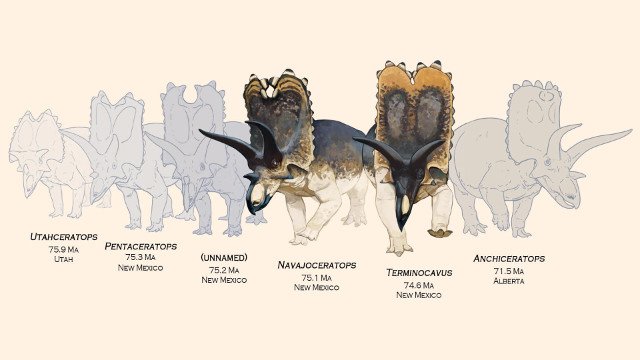
A hypothesis proposed already in the 1990s concerned the possibility that Pentaceratops sternbergii was an ancestor of Ankiceratops ornatus. The discovery of the new species Navajoceratops sullivani and Terminocavus sealeyi brings evidence to support it thanks to some intermediate characteristics that show an evolution of the skull’s shape. The evolution of a group of Chasmosaurinae could start even earlier, from another species already known called Utahceratops gettyi.
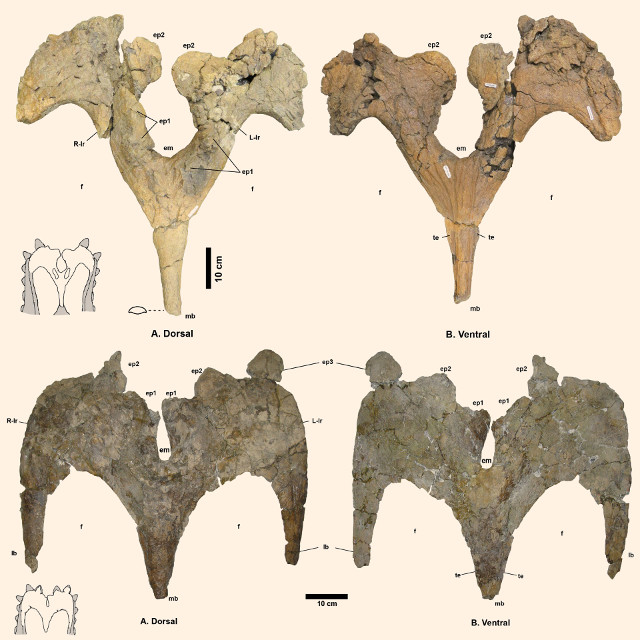
The top image (Courtesy Fowler & Freedman Fowler / PeerJ, doi: 10.7717/peerj.9251) shows bones of Navajoceratops sullivani at the top and Terminocavus sealeyi at the bottom. The bottom image (Courtesy Ville Sinkkonen & Denver Fowler. All rights reserved) shows these two species as transitional forms within a sequence of Chasmosaurinae.
The two species discovered fill a void that existed in the Chasmosaurinae’s fossil record and offer more information on the evolution of this group. Their characteristics indicate that there was a diversification between these horned dinosaurs compared to the genus Chasmosaurus. This occurred over 80 million years ago, in the Late Cretaceous period, when the sea flooded part of today’s North America dividing it into two subcontinents. The populations of Chasmosaurinae were separated causing an evolution in different species.
The case isn’t necessarily closed because incomplete fossils can leave the possibility of disputes and other interpretations. There’s also the problem of the other fragments discovered and indicated for now only as “Taxon C” that can still be studied and offer more information. There may still be news on the reconstruction of the history of these horned dinosaurs.