
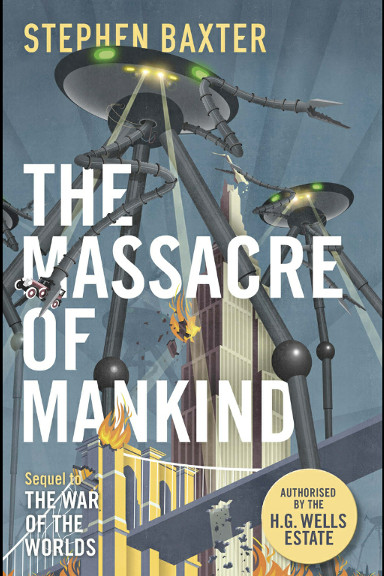
The novel “The Massacre of Mankind” by Stephen Baxter was published for the first time in 2017. It’s the sequel to “The War of the Worlds” by H.G. Wells.
Julie Elphinstone is a journalist who is in New York for her work when she talks to Walter Jenkins, the brother of her ex-husband and the author of the Narrative that told the Martian invasion. Walter is still dealing with the serious physical and mental consequences of that time and tells Julie that he has grave news.
Together with other people, Julie takes the journey to England, where she finds a difficult situation. The British have sided with Germany in the war raging in Europe, but soon the problems could get worse. Walter Jenkins explains to Julia that sigils have been sighted on Mars and Venus and that the Martians have fired at Earth again, this time with more cannons. The Jovians also manifested, displaying their sigil on the giant planet.
Stephen Baxter is known as one of the most important hard science fiction authors, “The Massacre of Mankind” is an exception, at least partial, because to continue the story told by H.G. Wells he also reprises some of his novel’s foundations that are obsolete today. According to the planetary formation models of the time, the planets were formed starting from the outer ones going towards the inner solar system. The consequence of this concept is that Mars was seen as an ancient, dying, planet, and the Martians as an ancient civilization in search of new resources. Earth was seen as a planet in its full vitality and Venus as a young and thriving planet. Jupiter is seen as an ancient planet, but still thriving thanks to its mass, and is home to a civilization even older than the Martian one.
“The Massacre of Mankind” begins in 1920, 13 years after the arrival of the Martians. That attack greatly influenced history and not just British history, so this novel also belongs to the alternate history subgenre. Historical characters are often mentioned in ways that emphasize the divergence of history from ours, for example with Churchill encouraging British troops to face the Martians or Thomas Edison inventing new weapons to fight the Martians.
The protagonist of “The Massacre of Mankind” is Julie Elphinstone, a journalist who tells her story in the first person adding the story of events experienced by other characters. Walter Jenkins, her ex-husband’s brother, is the author of what in the novel is called the Narrative, a reference to “The War of the Worlds”. Stephen Baxter carefully studied H.G. Wells’s novel to write a sequel that was consistent with it. At the same time, he expanded the story with a second Martian war that starts in England but this time the alien forces are much more massive and attack other nations as well. All this extends a novel that at times becomes repetitive, such as in the story of various attempts to hit the Martians, and heavy, as in wanting to add parts experienced by other characters around the world.
Julie Elphinstone’s first-person story with other characters coming and going makes their development often limited, even if the important ones have some characterization. Compared to “The War of the Worlds”, the sequel contains much more dialogue as the protagonist is less at the center of the action and more involved in meetings with other people. This means that sometimes the pace is slow and there’s no particular tension.
Stephen Baxter reproduced some of H.G. Wells’s stylistic choices, but in many ways “The Massacre of Mankind” is definitely his novel. This is the sequel to one of the novels that created science fiction, written over a century later, so their importance cannot be comparable in any way. In my opinion, overall it’s not bad, but it should be read as a curiosity, without great expectations.
