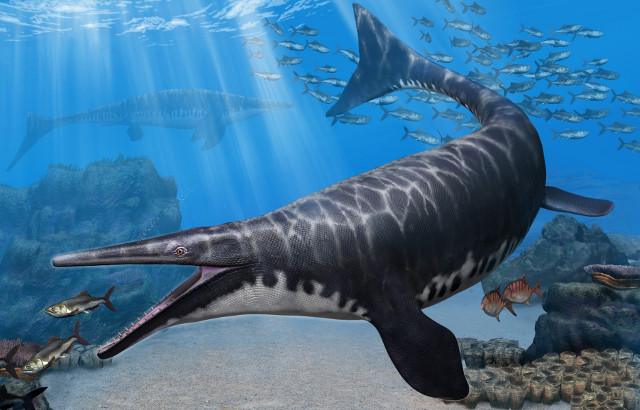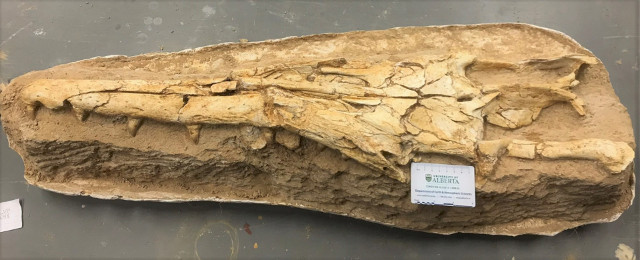
An article published in the “Journal of Systematic Palaeontology” reports the identification of a new species of mosasaur that lived between 66 and 72 million years ago, in the Cretaceous period. A team of researchers led by Catie Strong, a student in the Department of Biological Sciences at the University of Alberta, Canada, named it Gavialimimus almaghribensis after examining a skull and some bones discovered in a mine in present-day Morocco. The researchers noted the similarities of the teeth with those attributed to Platecarpus ptychodon, another mosasaur whose fossils were discovered in Morocco, but question the taxonomic validity of that species, so they created a whole new genus for the identified species.
In the marine environment existing in the Cretaceous period where now there is Morocco, several species of mosasaurs lived. The one that was examined in this study and named Gavialimimus almaghribensis (Fossil photo courtesy Catie Strong) had an elongated and narrow muzzle with interlocking teeth that shows similarities with those of the gharial (artistic illustration below courtesy Tatsuya Shinmura). This suggests a specialization that could explain the simultaneous presence of a number of mosasaur species, which tended to be top predators and therefore would have to compete for food in their environment.
Competition within a niche can lead either to the disappearance of one of the species or to a niche partitioning. In this case, niche partitioning means that a change in one of the species allows it for example to hunt different prey leading to a possibility of coexistence instead of competition.
According to Catie Strong, there’s evidence that each mosasaur species specialized by showing adaptations to hunt different prey or using different hunting styles. In the case of Gavialimimus almaghribensis, the very elongated snout and intertwined teeth perhaps helped it to grab fast-moving prey. Other species had less marked adaptations and likely had at least some preferences in common with regards to prey, but overall the evidence points to diversification into different niches.
An alternative explanation is direct competition among various mosasaur species in the same ecosystem. According to Catie Strong, the niche partitioning hypothesis is more consistent with the anatomical differences among the various species. This also shows the success of mosasaurs, which diversified during the Cretaceous period.
The study of the Gavialimimus almaghribensis fossil discovered in Morocco also highlights a problem with other mosasaur fossils discovered in the area. Platecarpus ptychodon is a species whose description published in 1952 is disputed, therefore Catie Strong’s team created a new one for the specimen examined despite the similarities with the teeth attributed to Platecarpus ptychodon. This shows the problems with research conducted several decades ago. Today the accumulated knowledge, also thanks to new technologies that allow in-depth examinations, offers much greater possibilities, also for the exchange of information among researchers all over the world.