
An article published in the journal “Genome Research” reports the DNA sequencing of Wolffia australiana, considered the fastest growing plant in the world. A team of researchers led by Todd Michael of the Salk Institute in La Jolla, California, USA, used advanced genetic sequencing techniques to accomplish this task. Understanding Wolffia australiana’s genetic characteristics means not only understanding how it grows so quickly but also how this plant is optimized for growth at the expense of other functions such as root growth and pest defense. The importance of this study also lies in the fact that the Wolffia australiana is part of the diet of some Southeast Asia populations, and a careful selection of its characteristics could make it an important protein source.
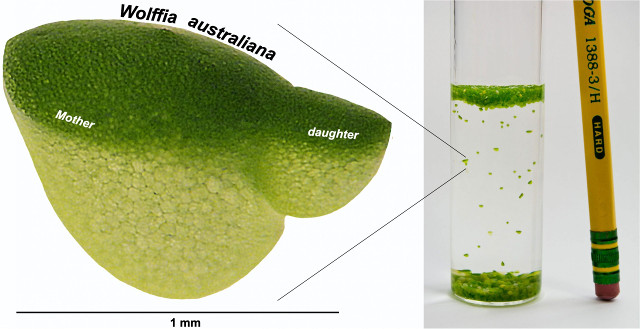
Wolffia australiana, and in general the species belonging to the Wolffia genus, grow in fresh water on all continents of the world except Antarctica. These are very small plants, so much so that their flowers are considered the smallest in the world. One plant is the size of a pinhead, and when seen in groups they look like small green seeds floating on water, as they have no roots. They’re humble plants which, however, have the characteristic of being able to double their size within a day.
The picture (Courtesy Sowjanya Sree/Philomena Chu. All rights reserved) shows the size of Wolffia australiana. On the left a Wolffia australiana plant showing how a new seedling sprouts directly from its mother and on the right a glass of water containing Wolffia australiana plants.
Wolffia australiana has relatively small DNA, the smallest in the Wolffia genus, as it’s made up of just about 15,000 genes. Despite that, this genome had not yet been sequenced. Now Todd Michael’s team reports the sequencing of two genomes of this plant to better understand its characteristics.
This study on Wolffia australiana went beyond genetic sequencing. The researchers grew this plant in various light/dark cycles to analyze which genes are active at different times of the day. The sequencing showed that it has half the number of genes regulating these cycles compared to other plants, and growth tests showed their activity. Todd Michael explained that he and his colleagues think its quick growth is due precisely to the lack of various genes that regulate those cycles and limit the growth of a plant.
Wolffia australiana’s sequencing also showed a lack of genes associated with pest defense and root development. In essence, it appears to have evolved focusing on quick, uncontrolled, growth. That’s important information to understand the genetic mechanisms of this and other plants, and this species could become important in their study.
Wolffia australiana is part of the diet of some Southeast Asian populations, a use that could expand in the coming years. Its quick growth could indeed make it even more interesting, and knowing its DNA could improve its production. It’s also a plant capable of purifying water in a natural way, so it could be used to clean up polluted lakes. Todd Michael’s team will continue to study its genetic mechanisms, so we can expect news on it in the future.
