
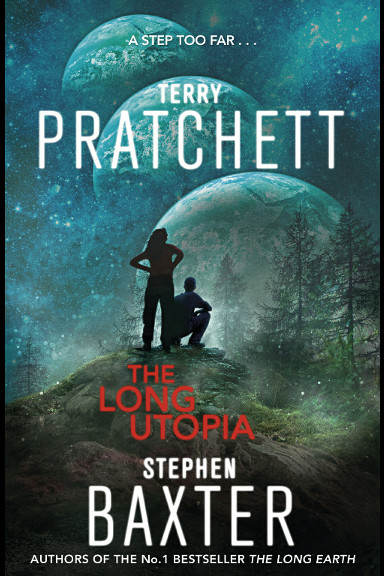
The novel “The Long Utopia” by Terry Pratchett and Stephen Baxter was published for the first time in 2016. It’s the fourth book of The Long Earth series and follows “The Long Mars“.
By the mid-21st century, the human species has spread over an indefinite number of parallel versions of the Earth. People who don’t want to be found can choose to move to another very distant Earth, on their own or by mixing with another group in which no one knows them. Lobsang tries this path by using a very natural-looking body produced exactly with the purpose of trying to live like a normal human being.
While Joshua Valienté is on the search for his father and ends up uncovering a much more complex past than he thought, it’s not always easy for ordinary humans to live with members of the new species that emerged among them. These are problems that may disappear when Lobsang discovers that he went to live in a world where seemingly impossible things are happening that clearly indicate that extremely powerful forces are at work.
“The Long Utopia” is the first novel in The Long Earth series published after Terry Pratchett’s death. Already in previous novels, the impression was that Stephen Baxter’s contribution had become predominant, and if “The Long Mars” didn’t have the names of both authors on the cover I would have thought it was written by Baxter only. The deteriorating health condition of Pratchett, who died on March 12, 2015, makes this scenario plausible.
“The Long Utopia” offers impressions similar to the previous novel also for a certain fragmentation between the various subplots. It’s a trend that has increased as the series progresses, as the protagonists started experiencing adventures that became increasingly autonomous. There are still some plots that justify it to be labeled as a novel even if, together with the previous one, seems more and more like anthologies of stories set on the Long Earth.
The first novels of the series told the expansion of humanity into a frontier that at least apparently is inexhaustible given that the number of parallel versions of the Earth seems infinite. Of course, not all of them are habitable but the amount of resources available, even taking into account other sentient species that inhabit some of them, seems sufficient for who knows how many generations.
War seems to have been rendered useless and the utopia of this novel’s title suggests the possibility that humans can finally live in peace. Reading the novel, the title seems ironic given that at least some of the developments seem to point in a direction very different from utopia.
The most significant elements of “The Long Utopia” are Joshua’s discovery of his family’s past and the further expansion of this fictional universe following Lobsang’s discoveries. The element of travel that initially marked this series has almost disappeared. On the Long Earth, decades have passed since it became normal for humans to travel to parallel worlds, so this makes sense. On the other hand, the important new elements increase this novel’s sense of fragmentation.
The themes developed in this series often change novel after novel, even in a radical way, and this doesn’t help readers who prefer a more homogeneous series. It’s as if the Long Earth has become a sort of container in which to set stories that are sometimes only vaguely connected. For this reason, “The Long Utopia” can please readers who appreciated the continuous evolution of the series and its protagonists.
