
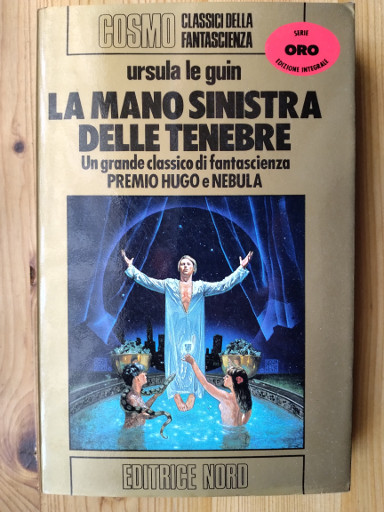
The novel “The Left Hand of Darkness” by Ursula Le Guin was published for the first time in 1969. It won the Hugo and Nebula Awards as the best novel of the year.
Genly Ai is an envoy of the Ekumen who has obtained an audience with Argaven Harge XV, the king of Karhide, the nation of the planet Gethen in which he managed to have the most important contacts. That result was achieved thanks to Prime Minister Estreven, who seems very interested in the possible alliance between Karhide and the Ekumen. However, the night before the audience, Estreven warns Genly Ai that he can no longer contribute to his cause.
Puzzled by Estreven’s behavior, Genly Ai prepares for a meeting with the king but discovers that there have been major changes in the government with the appointment of a new prime minister and Estreven getting exiled. The king rejects the Ekumen’s alliance proposal and Genly Ai decides to make another attempt in another nation but ends up entangled in political intrigues he doesn’t understand.
The daughter of an anthropologist, Ursula Le Guin was influenced by her father’s activity in developing the themes of her works. That influence includes the idea of the Ekumen, an alliance of various worlds in a fictional universe in which she set various works from the very beginning of her career.
Even within the Ekumen cycle, many works are autonomous. In the case of “The Left Hand of Darkness”, the Ekumen remains somewhat in the background but the presence on Gethen of an envoy of that alliance is crucial for the future of that planet’s nations.
Gethen and its inhabitants have some peculiarities that are central to the novel. The planet is almost completely covered in ice, and that’s crucial in its history. The inhabitants are human but have unique physiology because they change sex over the course of a monthly cycle.
Genly Ai is an alien on Gethen in many ways. Being permanently male represents a greater difference from the natives than many cultural differences. Despite this, he manages to establish a personal relationship with Estreven, who is initially Karhide’s prime minister, and then falls from grace. It’s a central relationship in the development of themes such as the encounter between people from different societies.
To begin his mission, Genly Ai traveled among the stars but that’s no big deal compared to the journey he makes on the planet Gethen. Despite his training, the protagonist is alone in an inhospitable place and above all among people who don’t have his own points of reference connected to gender. Today, gender issues are addressed, even in science fiction, and certain negative reactions that sometimes are violent show the difficulty of many people in moving beyond the fixed concepts of male and female. Over 50 years ago, Ursula Le Guin addressed the issue by imagining a population whose gender would today be defined as non-binary or fluid.
Genly Ai’s intentions are good but he struggles to relate to Gethen’s inhabitants. In the end, his journey is above all an inner one and Ursula Le Guin develops it in a way that is definitely non-trivial. In a story made above all of interpersonal relationships, the protagonist struggles to understand attitudes like Estreven’s. Certain political and social elements such as monarchy and concepts such as homeland and loyalty are familiar to him but the elements alien to him confuse him and force him to question his beliefs and his mental schemes.
A lot of things happen during Genly Ai’s mission but “The Left Hand of Darkness” is hardly an action novel. Ursula Le Guin offers details on the societies of the planet Gethen but she focuses on the more introspective side with depth and sensitivity. For this reason, it’s a novel to savor, better if repeatedly to better appreciate all the food for thought. For these reasons, this is still a very important novel, a must-read regardless of genre labels.
