
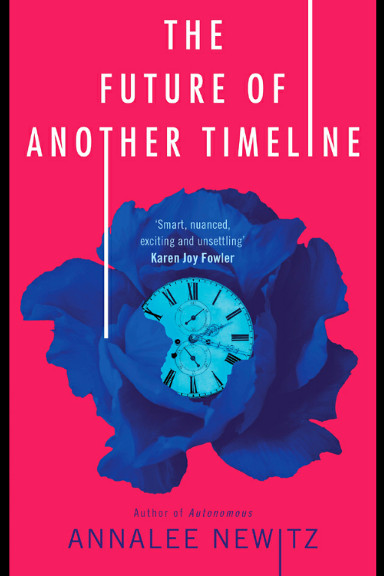
The novel “The Future of Another Timeline” by Annalee Newitz was published for the first time in 2017.
Tess is on a mission in time that aims to change the timeline for the better. Some men are trying to eliminate all women’s rights and then destroy the Machines that allow time travel making the timeline they created fixed.
While she’s passing through 1992, Tess goes to a concert where she knows that her younger version is present together with her friends. For those girls, still teenagers, it’s a key moment as they end up killing a schoolmate to save one of them. The girls hide their murder but the consequences will be heavy and Tess has already lived through them.
Typically, a story focused on time travel includes the rules it follows. In “The Future of Another Timeline”, the only certainty Annalee Newitz offers is that a journey through time can change history. The characters have many doubts about how time travel works and the consequences of the travelers’ actions, so much so that there are various discussions on the subject.
Uncertainty is an integral part of the plot and the characters act to the best of their knowledge without knowing whether parallel universes exist and changes to the timeline lead to crossing into another universe or time is more like a big ball of wibbly-wobbly timey-wimey stuff. The influence a single person can have, as opposed to collective actions, is also the subject of debate and uncertainty.
The central problem is that, in the timeline from which Tess starts, time travel is achieved thanks to the Machines but their exact nature isn’t clear. They’re extremely ancient and have been discovered by humans in various parts of the world. Humans slowly learned how the Machines work through trial and error but that knowledge is far from complete.
In a timeline where history can be changed, a sort of time war breaks out between a group of men who seek to eliminate women’s rights from history and a group of women who oppose them and try to improve women’s situation.
Annalee Newitz uses historical characters in constructing her novel’s plot with Anthony Comstock, a 19th-century American moralizer, at the center. Discussions about timeline changes, also linked to uncertainties about how to achieve them and their consequences, are used to develop ethical and moral issues connected to the struggle around women’s rights. The presence of LGBT+ characters extends the issue to that minority. Part of the story is set in the 19th century and also shows how common racism and anti-Semitism were.
Even when it comes to science fiction stories, whose readers are supposed to have an open mind, there are complaints whenever a work has explicit feminist or LGBT+ contents, which are dismissed as just politically correct. Annalee Newitz is part of that community, so she writes about people like those she knows directly.
Recent history, current events, and what’s happening in many nations show how many forms of discrimination are still common and even rooted. This makes the events of the 19th century seem much closer and more relevant.
Honestly, it can be difficult to feel close to the protagonists of the novel, for different reasons. It can be impossible to fully understand the problems of people who are discriminated against if you don’t suffer such discrimination. However, “The Future of Another Timeline” shows the relevance of certain themes, the resistance to recognizing rights to other people for moralisms and mental closure. It’s a complex novel in many ways but I believe Annalee Newitz gave strength to the most important elements, and that makes it a must-read for anyone interested in these issues.
