
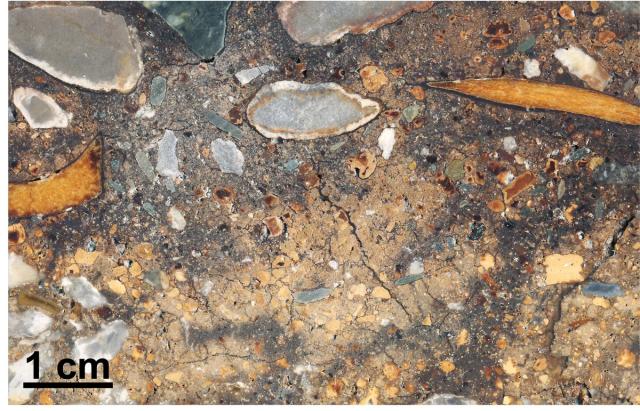
An article published in the journal “Proceedings of the National Academy of Sciences” reports the discovery of DNA of ancient hominins and animals dating back to the Pleistocene period in sediments taken from 13 prehistoric sites on different continents. A team of researchers including scientists from the Max Planck Institute for Evolutionary Anthropology in Leipzig and geoarchaeologists collected and analyzed sediments and found that even microscopic fragments of bone and feces offer concentrations of DNA belonging to various species. That’s another step forward in the recovery of very ancient genetic material that can offer valuable information on populations of Neanderthals and other hominins whose presence can be linked to archaeological artifacts and ecological traces.
Geoarchaeologists are archaeologists who apply geological techniques to reconstruct the formation of sediments and sites. Their work has become even more important thanks to the techniques developed in recent years to recover DNA preserved in sediments. That work is done in collaboration with paleogeneticists who study the DNA of ancient, often extinct, species. The Max Planck Institute for Evolutionary Anthropology is today the most important paleogenetic center in the world and is vastly expanding our knowledge of various populations of ancient humans.
In recent years, new techniques developed to recover DNA from sediments led to several genetic studies, in this case on samples collected over the past 40 years in a total of 13 sites dating back to the Pleistocene period on various continents. Examination of samples kept in storage for decades also yielded positive results with DNA recovery. This offers excellent prospects for further study, as there’s a vast amount of sediment samples collected around the world from many archaeological and paleontological sites that could be reexamined.
In this study, the researchers identified concentrations of DNA in bone fragments as well as in feces particles. Among the sites from which the examined samples come is the Denisova cave in Siberia, famous for the discovery of bones belonging to the ancient human species named after it. It’s been inhabited by different populations over many millennia, and the researchers identified from the sediments the DNA of at least two adult male Neanderthals related to the one cataloged as Denisova 5, whose toe bone had previously been discovered in the same sediment layer.
This type of study is increasingly multidisciplinary because the results make it possible to link a specific population to the archaeological artifacts discovered in a certain layer of a site. The remains of animal and plant species but also minerals that can be linked to geological processes can help to reconstruct the ecology of the various eras connecting the different populations to the environments in which they lived. In essence, these are genetic studies that are offering excellent results with various ramifications in various scientific disciplines.
