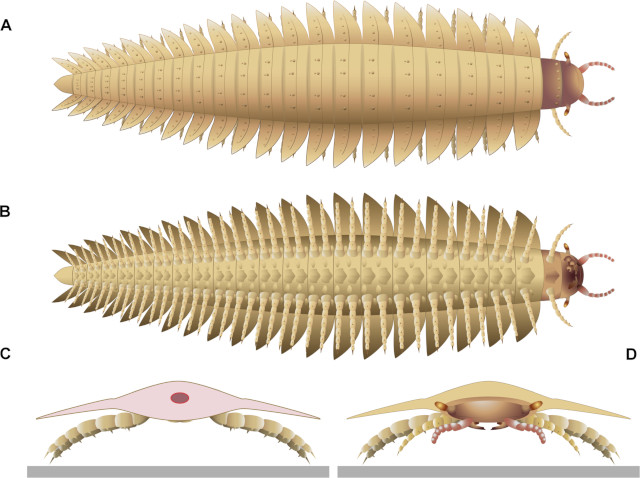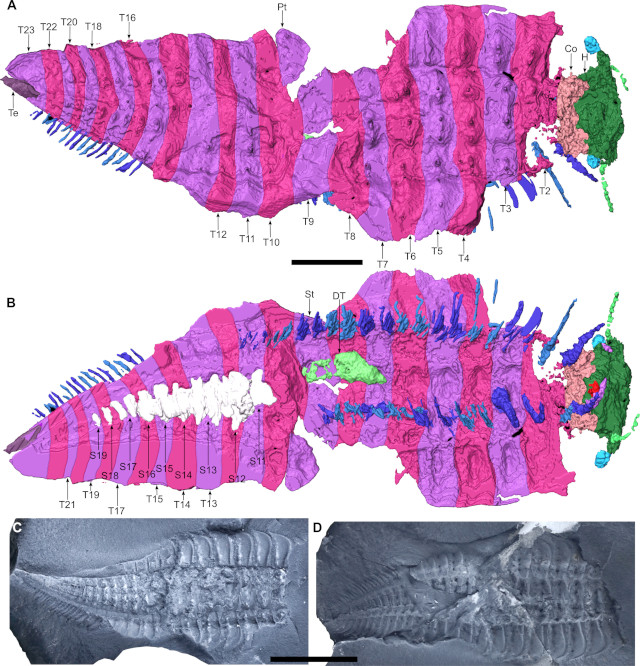
An article published in the journal “Science Advances” reports the results of the reconstruction of the body and in particular of the head of an Arthropleura, a genus of millipedes that lived between 350 and 290 million years ago. A team of researchers subjected some of the fossils discovered in France in the 1980s to a CT scan that allowed them to obtain details that were previously hidden in the rock and 3D reconstructions. These are small Arthropleura and it’s not certain that they would have reached the over 2.5 meters estimated for their maximum length but they still offer information on these giant myriapods. In another article published in the same journal, paleobiologist James Lamsdell of West Virginia University describes the history of studies of these millipedes.
The top image (Courtesy Mickaël Lhéritier et al) shows a 3D reconstruction of the specimen cataloged as MNHN.F.SOT002123 of Arthropleura in a dorsal (A) and ventral (B) view along with views of the fossil (C, D). The bar is 5 millimeters long in A and B and 1 centimeter in A and B.
The first fossils attributed to the genus Arthropleura were described in 1854 and are among the few arthropods that stimulated the imagination of people outside the field of paleontology due to their remarkable size. However, due to the fragmentary nature of the fossils discovered, there have been many discussions about their classification within the arthropod phylum, their relationships to modern myriapods, and their anatomical features, also regarding the classification of the fossils into different species. The species Arthropleura armata is the one that is generally accepted.
In the 1980s, fossils of small Arthropleura specimens in excellent condition were discovered in a deposit near Montceau-les-Mines, France. The problem was to free specimens that are a few centimeters long from the rock to examine their details without damaging them. Modern technology made it possible to circumvent this problem.
In recent years, the application of tomographic techniques developed in the medical field adapted to paleontology has become increasingly common. In the case of fossils of small Arthropleura, some specimens were subjected to CT scans and the specimen cataloged as MNHN.F.SOT002123 was revealed to have a complete head. The bottom image (Courtesy Mickaël Lhéritier et al) shows a 3D reconstruction of this specimen in a dorsal (A), ventral (B), posterior (C), and frontal (D) view.
The results of the fossil examination indicate that these animals essentially had the body of a millipede but the head of a centipede. It may seem like a small difference but today these arthropods are part of four different classes. The researchers offered their interpretation of the data connected the possible kinship with the various groups of myriapods.
This study involved specimens of Arthropleura that were still very small, so it didn’t go into the merits of the size they could reach. According to estimates, they could approach three meters in length, so they compete for the record of the largest arthropods ever lived with some sea scorpions that lived in the Silurian and Devonian periods, the ones following the periods in which Arthropleura lived.
There are still questions waiting to be answered about these arthropods. No food remains were found, so there’s no certainty about their diet. No remains of their respiratory system were found, so the possibility remains that they had some type of lungs that allowed them to reach a considerable size. At the time of the giant arthropods, it’s estimated that there was much more oxygen in the atmosphere, up to 35%, but some species still seem too large to survive without a respiratory system based on lungs.
Arthropleura lived in humid forests that shrunk in the early Permian period, when the climate became drier. The change in conditions included a decrease in oxygen in the atmosphere that was probably crucial in determining the extinction not only of these myriapods but also of giant land insects. Reconstructing those arthropods that are enormous compared to the ones that exist today and the ecosystems in which they lived is not easy but it helps to understand the conditions that existed in that remote time.