
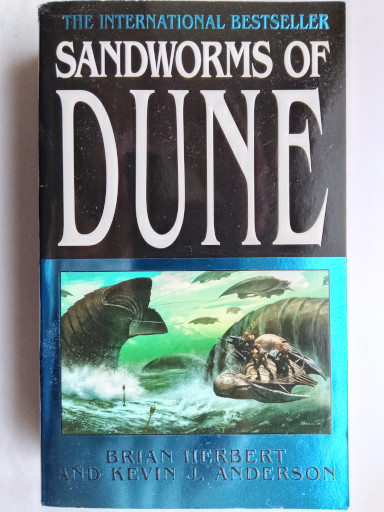
The novel “Sandworms of Dune” by Brian Herbert and Kevin J. Anderson was published for the first time in 2007. It’s the eighth book in the Dune saga and follows “Hunters of Dune“.
The starship Ithaca continues its journey, which reached a twenty-year duration. Aboard, the project for new gholas continues, though not everyone is in favor. Failures in certain Ithaca systems may be due to a lack of maintenance, but in some cases, there are clear signs of deliberate damage.
On Chapterhouse, Murbella tries to develop a plan that will give humanity hope against the Enemy after discovering the identity of the two mysterious figures. New starships and weapons must be produced, but Face Dancers are ready to sabotage these efforts.
“Sandworms of Dune” picks up where the previous book left off, forming a single novel. Brian Herbert and Kevin J. Anderson wrote what Frank Herbert had planned as the final novel in the Dune saga, dividing it into two books. Reading them, one can’t help but wonder how much of the plot was developed from Frank Herbert’s notes and how much was made up by the authors, also to connect it to their prequels.
Both thematically and stylistically, “Sandworms of Dune” is far more similar to the prequels than to Frank Herbert’s original novels. Writing a direct continuation of “Chapterhouse Dune” forced the authors to at least make an effort to maintain a modicum of continuity in concluding what was originally intended as a trilogy. As the subplots developed, the authors gradually distanced themselves from that style, transforming this novel into a space opera that has lost the subtleties typical of the Dune series.
The division of the final novel into two books was justified by the abundance of developments highlighted in Frank Herbert’s notes. Reading the various subplots, one wonders whether all the ramifications were really planned. In various cases, one gets the impression that they were all too often filler, typical of Kevin J. Anderson’s style.
Of course, it’s possible that the authors simply interpreted in their own way some ideas actually present in Frank Herbert’s notes, reducing them to all-too-often superficial adventures in which the protagonists completely lack the depth with which they were created. Too often, some characters’ behaviors seem to be driven simply by the will to advance the plot in a certain way, without considering their consistency with their characteristics.
The consequence of the authors’ choices is that far too many plot developments that are supposed to be exciting because they lead to the climax of the entire saga are dull and superficial instead. What are supposed to be major twists that lead to the final resolution, which changes the course of human history, are essentially deus ex machina. This choice suggests, above all, the authors’ desire to combine the narrative elements they introduced, sometimes forcefully, with those developed by Frank Herbert in the original books.
This result is also determined by the fact that characters who have marked the Dune saga are wasted. The abundance of subplots sometimes seems like a way to cover up the fact that developments are simplistic, and even the most extraordinary strategists seem incapable of going beyond the most basic plans. For readers who appreciated these characters’ skill in battle and intrigue, this can be very disappointing. On the other hand, if you have read the prequels, you shouldn’t be surprised that everything ends this way, especially if you have also read some of Kevin J. Anderson’s other novels.
If you’re happy with any ending to the Dune saga just because it’s labeled as official, you’ll be OK with “Hunters of Dune” and “Sandworms of Dune”. If you want an ending that respects Frank Herbert’s style and themes, you might as well write your own fan fiction. You can find it on Amazon USA, UK, and Canada.
