
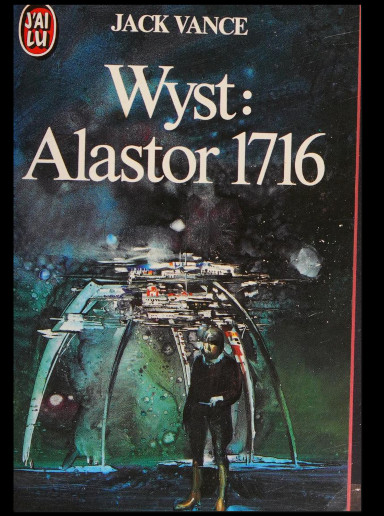
The novel “Wyst: Alastor 1716” by Jack Vance was published for the first time in 1978. It’s the third book in the Alastor trilogy and follows “Marune: Alastor 933“.
Representatives of the Arrabus territory, the most important on the planet Wyst, have requested an audience with the Connatic, ruler of the Alastor Cluster, to ask for his help. Their society is based on total egalitarianism, but this is bringing negative consequences, such as unmanageable immigration. For the Connatic, the situation is unclear because he has lost contact with his representatives on Wyst.
Jantiff Ravenstoke is a young resident of the planet Frayness drawn to the Arrabus society. He believes that egalitarianism in what seems like a utopia could help him develop his artistic career and, in general, find his life path. Soon, however, he must also confront the darker side of Arrabus society.
“Wyst: Alastor 1716” concludes the trilogy of novels set in the Alastor Cluster. They can be read independently, as they share only their setting. The worlds of Alastor are governed by a single authority, the ruler called Connatic.
This novel is in many ways a satire of a society that presents itself as an egalitarian utopia. The inhabitants of Arrabus must work only a few hours a week and can do whatever they want otherwise. When Jantiff Ravenstoke arrives on the planet Wyst, he immediately encounters the first problems of this social structure when he risks being rejected at customs because the clerk isn’t up to date with the papers required to enter Arrabus.
Jack Vance often includes moments in his stories where bureaucracy created problems for the characters. In this case, this is combined with the incompetence of employees assigned to a certain job for a few hours. It’s a way to show from the beginning the problems of Arrabus’s egalitarian society.
Initially, Jantiff Ravenstoke’s story is rather funny because his roommates in the apartment assigned to him appear superficially friendly, but, as a matter of fact, they annoy him in a thousand small ways, always stressing Arrabus’s egalitarianism with him. He discovers the hard way that theft is actually legal in Arrabus because, according to the inhabitants, it ensures that no one owns a concentration of material goods.
The tone of the story becomes more dramatic when Jantiff Ravenstoke becomes unwittingly involved in events concerning his roommates. Another dark side of Arrabus society is linked to the sport called hussade, a version of which is played on Wyst that has a dramatic ending.
The Connatic, who rules the entire Cluster, is often mentioned in the Alastor trilogy, but he doesn’t appear directly in the previous novels. He’s said to travel incognito to interact with commoners in a natural way, so it’s possible that some characters are actually the Connatic. In this case, the Connatic appears in an official capacity but could also appear incognito.
“Wyst: Alastor 1716” is a peculiar novel because Jack Vance gives it a very strong mark of political and social satire, far more than his usual approach, while also incorporating elements more typical of his works. In my opinion, this novel is worth reading, along with the other two in the Alastor trilogy. You can find it on Amazon USA, UK, and Canada.
