
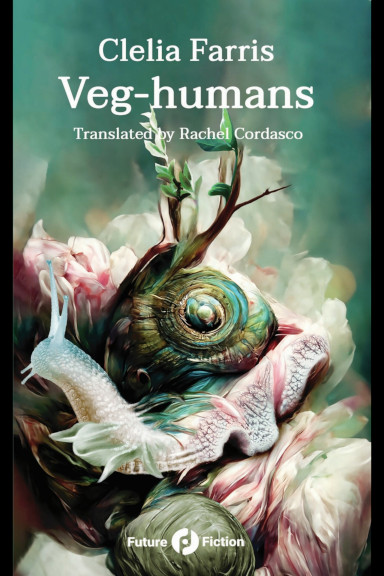
The novel “Veg-humans” (“I Vegumani”) by Clelia Farris was published for the first time in 2022. It was translated into English by Rachel Cordasco.
For the agricultural cooperative Astarte, every day is a challenge to produce something despite the very difficult climate conditions. Many people emigrate to the Arctic, where the climate is mild, and it’s still possible to practice agriculture as previous generations did, but others don’t want to leave their homeland.
Experts promise rain, which would greatly help the Astarte partners, but not everyone believes their predictions. Gazania works on a sunscreen that might help workers stay outdoors longer, but discovers that one person who used it has literally taken root.
“Veg-humans” takes us to a future where the effects of climate change have severely impacted humanity. This is typically considered a post-apocalyptic or quasi-post-apocalyptic story because it depicts a future where even the Mediterranean area is barely habitable due to the climate conditions. However, Clelia Farris approaches these themes with the attitude of the solarpunk subgenre, which stems from a movement that seeks to imagine a future that offers reasons for optimism despite the problems already affecting the world today and which will worsen in the future.
The society that exists in the future described by Clelia Farris continues to function despite the difficulties caused by climate change. That situation is central to the plot, and in recent years, a genre called climate fiction (cli-fi) has developed that specifically explores the problems connected to climate change.
The members of the Astarte cooperative are young people who strive to cultivate crops using advanced biotechnology. Through their actions and conversations, the reader discovers the problems they face and the differences between those who want to stay and keep their land alive and those who are tired of struggling against the desert and are tempted to emigrate to the North, where the climate is mild.
Roots are central to this novel, both metaphorically and literally. Gazania works on a sunscreen, and it’s a task that could make all the difference in a place where it’s difficult to be outdoors during the day due to the almost unbearable environmental conditions. Being able to work an extra hour outdoors in those harsh conditions could determine the survival of the Astarte cooperative.
When Gazania discovers that her cream literally makes those who use it grow roots, she tries to understand what component has caused this unexpected effect. What seems like an unexpected consequence becomes a way to explore new possibilities for survival and the differences from the solutions sought by previous generations. The cooperative’s members are young, but the characters include Granny, who seems useless but remembers the old days and the limitations of the generations who caused the problems and didn’t find solutions sufficient to avert the disaster.
A lot happens throughout the story, but this is certainly not an action novel. The exchanges of opinion between characters, the scientific elements behind the attempts to make agriculture work under very difficult conditions, and the attempts of people like Gazania to adapt are used by Clelia Farris in “Veg-humans” to offer a lot of food for thought on the current situation we’re experiencing and its consequences. There’s truly a lot to think about, and for this very reason, I recommend reading this novel. You can find it on Amazon USA, UK, and Canada.
