

An article published in the journal “Nature Ecology & Evolution” reports a study of the fossils of the so-called Turkana boy, the most complete early human skeleton found so far. A team of paleoanthropologists led by Markus Bastir of the Museo Nacional de Ciencias Naturales in Madrid and Daniel García-Martínez of the Centro Nacional de Investigación sobre la Evolución Humana (CENIEH) in Burgos, Spain, created a three-dimensional reconstruction of the Turkana boy’s rib cage to compare their characteristics with those of other hominins. The result is that it was stockier than Homo sapiens, different from the idea of the first runners that paleoanthropologists have of Homo erectus and Homo ergaster.
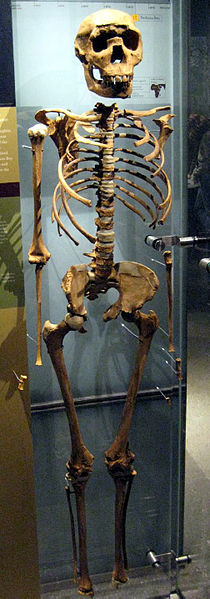
Turkana boy (photo skeleton ©Claire Houck), formally cataloged as KNM-WT 15000, was discovered in 1984 in the bank of the Nariokotone river, near Lake Turkana in Kenya. This young individual, who died about 1.5 million years ago at an age between 7 and 11 years old, was attributed to the species Homo erectus. Later it was attributed to the species Homo ergaster, also known as the African Homo erectus. There are discussions about whether they were two different species or Homo ergaster was a subspecies of Homo erectus. The authors of this study of the Turkana boy speak of it as a Homo erectus.
In general, paleoanthropologists believe that Homo erectus was the first hominin to have human physical characteristics such as the ability to run for a long time. Anatomically, this means having tall and slender bodies that represent an advantage in the hot and dry savannah where Homo erectus emerged because they’re useful features also to avoid overheating. Known Homo erectus fossils suggest that they had longer legs and shorter arms than Australopithecines.
The skeleton of the Turkana boy lacks hands and feet, but otherwise is almost complete and is therefore excellent to compare its characteristics with Homo sapiens and Neanderthals as well. The applications of advanced technologies to paleontology are allowing to study the characteristics of extinct species in ways unthinkable not long ago. In the Turkana boy’s case, the three-dimensional reconstruction (image ©Markus Bastir, CC-BY-NC-ND 4.0) of his ribcage allowed a comparison with what are believed to be his descendants with surprising results.
 The Turkana boy’s chest turned out to be much wider and more voluminous than that of most humans living today. That means he was stocky, closer to the Neanderthals than to the Homo sapiens, which suggests that modern humans changed from that point of view more than previously thought and that the Neanderthals had instead maintained those characteristics. Markus Bastir and Daniel García-Martínez had already performed a similar reconstruction for a Neanderthal whose results were published in an article in the journal “Nature Communications” in October 2018. This made it easier to make the comparison.
These three-dimensional reconstructions help to understand not only the anatomical details of the individuals examined but also how they breathed. These are more useful information to reconstruct the evolution from Homo erectus / ergaster to Neanderthal and Homo sapiens with their differences. This study suggests that the appearance of modern humans is actually relatively recent, so further research is needed to understand its evolution.
