
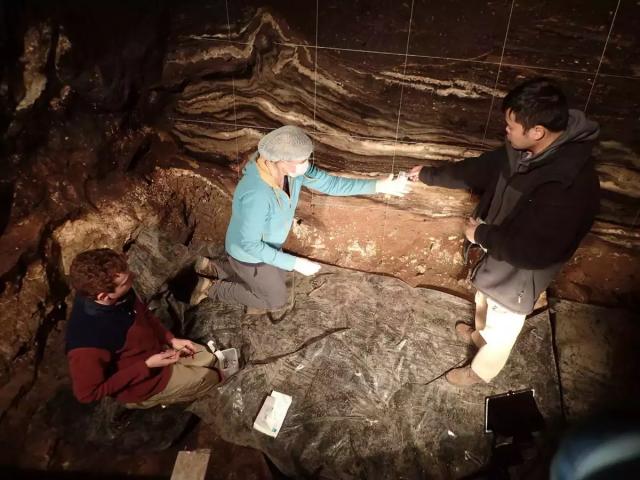
An article published in the journal “Nature” reports the results of the sequencing of DNA found in the sediments of the Denisova Cave, in Siberia. A team of researchers achieved the largest sequencing ever conducted on genomes recovered from sediments from a single site with 728 samples. The results offer a picture of the occupation of that cave over a period of more than 300,000 years by three human species: the Denisovans, the Neanderthals, and the Homo sapiens. However, most of the samples turned out to be DNA from various animals, which is also useful because it offers information on the connection between humans and the species that various populations ate.
Denisova Cave is a very important site in the study of human history because it’s been inhabited for over 300,000 years by different human species, in some cases probably in the same period. The conditions in Siberia are such that many bones have been found in an excellent state of conservation, allowing DNA to be extracted and the existence of a human species other than Homo sapiens and Neanderthals, the Denisovans, to be discovered.
In April 2017, an article published in the journal “Science” described a new method for collecting DNA from sediments present in archaeological sites, even when no bone remains are present. Initially, this method allowed to extract only mitochondrial DNA but this allowed to obtain results that are still interesting.
Michael Shunkov of the Russian Academy of Sciences led the excavations at Denisova Cave and assembled an interdisciplinary team to study the site. Geochronologists led by him and Professor Zenobia Jacobs of the Australian University of Wollongong collected the 728 samples in various areas of the cave.
The samples were sent to the Max Planck Institute for Evolutionary Anthropology in Leipzig, Germany, where PhD student Elena Zavala led the extraction of mitochondrial DNA and its analysis, a task that lasted about two years. In 685 samples the DNA of animals was found while in 175 samples they found human DNA belonging to individuals of the various species that lived in the Denisova cave.
The results indicate that the oldest genomes belong to the Denisovans, who produced the oldest stone tools discovered in the cave between 250,000 and 170,000 years ago. The first Neanderthals arrived at the end of that period and thereafter there are traces of both species in that area. An exception is the period between 130,000 and 100,000 years ago, in which only traces of Neanderthals were found. The mitochondrial DNA of the Denisovans who arrived later is different from that of the previous ones, indicating that they were a different population that arrived in the area.
The most recent DNA is that of Homo sapiens and dates back to about 45,000 years ago. This is the Initial Upper Palaeolithic, the last phase of the so-called stone age. The layer in which the DNA of modern humans was discovered also contained tools and other objects, more sophisticated than those of previous eras. Elena Zavala pointed out that this suggests that they may have brought new technologies to the region.
The discoveries about the presence of animals are also interesting. The changes in the fauna occurred together with those of the hominins. 190,000 years ago there was a climate change from relatively warm conditions to a glacial period. At that time there was a change in the hyena and bear populations and the Neanderthals arrived in the cave. Between 130,000 and 100,000 years ago, climate change brought greater warmth and it’s the period in which no traces of Denisovans were found in the cave while other changes in the local fauna were detected.
This and other recent studies in paleogenetics, which concern the DNA of extinct species, are offering really interesting results thanks to the development of DNA extraction techniques from sediments. Organic fragments such as hair can be preserved in caves that were inhabited for many millennia. This offers the possibility of obtaining more information about those inhabitants that can be invaluable in the reconstruction of the history of humanity.
