Planets

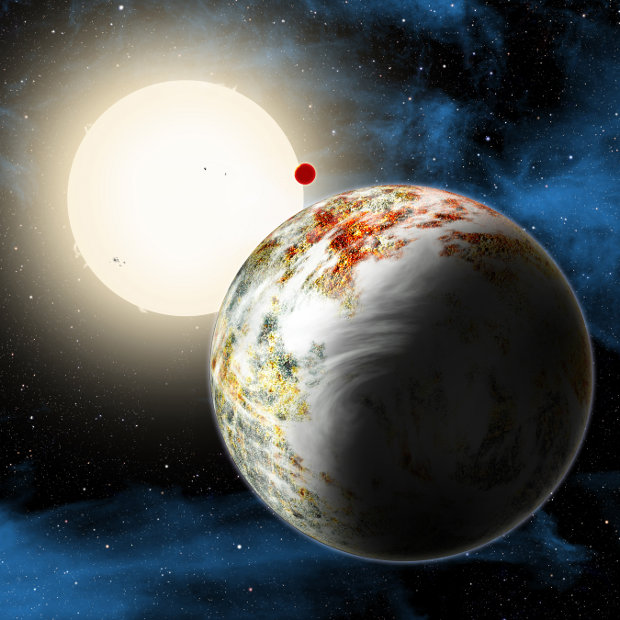
Artistic impression of the Kepler-10 system with the planet Kepler-10c in the foreground (Image Harvard-Smithsonian Center for Astrophysics/David Aguilar)

A team of astronomers led by Xavier Dumusque of the Harvard-Smithsonian CFA (Center for Astrophysics) has discovered a planet different from those found so far that has been called mega- Earth. It is a rocky planet that is much larger than astronomers had expected from a planet of this type. The planet Kepler- 10c has a size that is approximately 2.3 times that of Earth , but above all has a mass about 17 times greater.

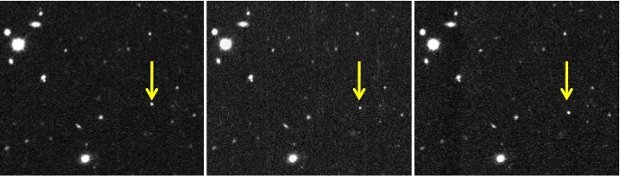
2012 VP113 movements recorded on November 5, 2012 (Image Scott Sheppard/Carnegie Institution for Science)

The astronomers Chadwick Trujillo, of the Gemini Observatory in Hawaii, and Scott Shepherd, of the Carnegie Institution for Science in Washington DC, have announced the discovery of what is probably a dwarf planet. Called for now only 2012 VP113, it has a diameter around 450 kilometers (about 280 miles). Its uniqueness is that its orbit is remarkably far from the Sun as it does not get closer than 80 astronomical units, about twice Pluto’s average distance from the Sun.

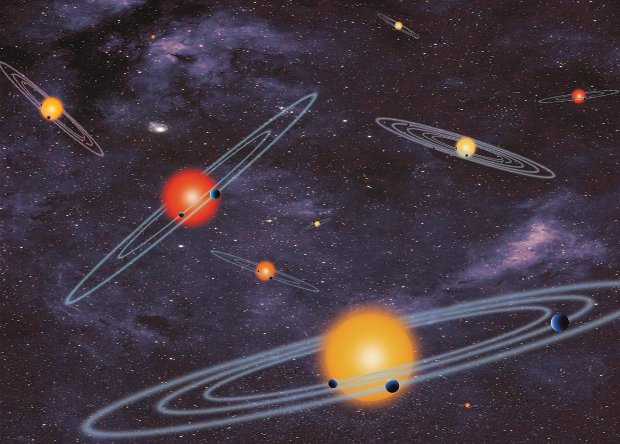
Artistic concept of some multiple-planet systems found thanks to the Kepler Space Telescope (Image NASA)

Yesterday NASA announced a truly sensational discovery because 715 new exoplanets were found. These are the results of a new type of analysis performed on the data collected during the first two years of observations by the Kepler space telescope. This new method allowed to confirm that 305 stars have a multiple-planet system. So far, almost 1,000 planets were confirmed therefore confirming other 715 at once is a huge leap forward in the search for exoplanets.

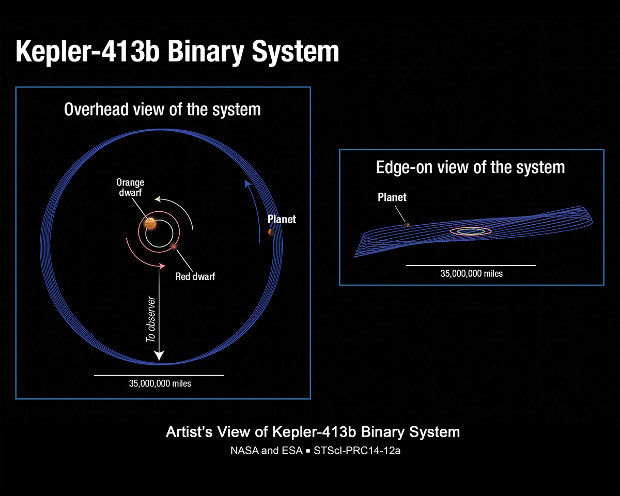
Illustration of the planet Kepler-413b orbit (Image NASA, ESA, and A. Feild (STScI))

While NASA is still analyzing the proposals for a new use of the Kepler space telescope after the end of its mission, scientists are still examining the data collected in the past years. The observations of the binary system Kepler-413 have allowed them to discover an exoplanet called Kepler-413b that’s really pecutliar, especially because its axis wobbles like a spinning top, causing violent changes in its seasons.