Planets

The Mars Rover Opportunity's route on Mars (Image NASA/JPL-Caltech/MSSS/NMMNHS)

At 5:05 UTC on January 25, 2004, the Mars Rover Opportunity landed on Mars. Therefore, it’s been 10 Earth years since this extraordinary robot started its 3-month mission. Two years ago, when I wrote an article celebrating the eighth anniversary of its landing, Opportunity was already the holder of the record for longevity for missions one the surface of Mars, today it’s also the robot that holds the record for the distance traveled on the surface of another world with 38.7 km (24 miles), more than the 37 km (23 miles) traveled by the Soviet Lunokhod 2 robot on the Moon.

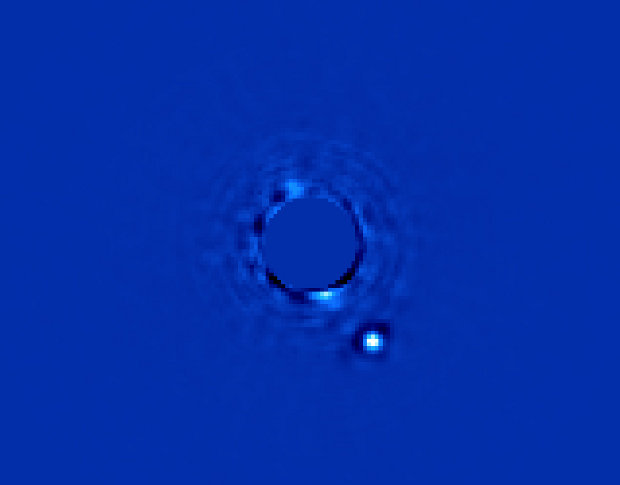
The star Beta Pictoris and its planet Beta Pictoris b observed by the Gemini Planet Imager (Image Gemini/Christian Marois, NRC Canada)

After nearly a decade needed for its development, construction and testing, in recent days the Gemini Planet Imager (GPI) officially came into operation. It’s a huge camera built to take pictures of exoplanets. It was deployed on the Gemini South telescope in Chile, one of the two large twin telescopes with a diameter of 8.1 m (26.9 ft) each that form the Gemini – which means twins – Observatory.

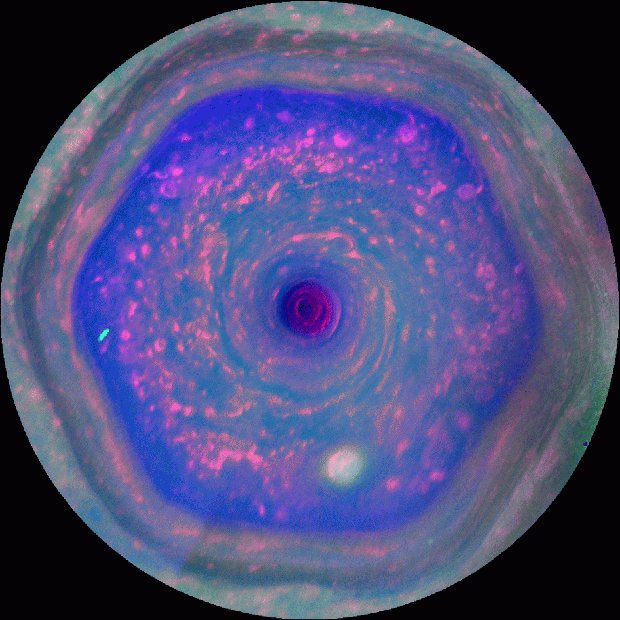
Picture of the hexagon, the huge hurricane on Saturn's north pole, taken by the Cassini space probe (Photo NASA/JPL-Caltech/SSI/Hampton University)

The hexagon shaped hurricane that occupies the entire north pole of Saturn has fascinated astronomers since it was discovered during the Voyager missions in the early ’80s. About a year ago, the Cassini spacecraft passed above it and, thanks to a favorable sunlight, it was able to take high resolution pictures of this peculiar weather phenomenon. Now NASA has released these photos during a Google+ hangout that had purpose to present them.

The image created by Gordan Ugarkovic using photographs taken by the Cassini space probe (Image NASA/JPL-Caltech/Space Science Institute/G. Ugarkovic)

NASA’s Cassini space probe has taken a lot of pictures of the planet Saturn and its rings. It’s a show that keeps on fascinating us and Gordan Ugarkovic, a Croatian member of the UnmannedSpaceflight.com group, has brought together 36 photographs available in the Cassini mission archive to create a complete image of the planet as seen from its north pole, with its rings in evidence.

The Eden Patera crater on Mars (Image ESA)

According to a research conducted by Joseph R. Michalski of the Planetary Science Institute and Jacob E. Bleacher of NASA’s Goddard Space Flight Center just published in the journal “Nature”, a crater on Mars wasn’t created by an impact but is what remains of an ancient supervolcano.